A silent underground menace is spreading across India's mustard heartlands, threatening the country's largest indigenous source of edible oil. The parasitic weed Orobanche aegyptiaca, known locally as 'margoja', is inflicting severe damage in major mustard-growing states like Rajasthan and Haryana, leading to significant yield losses and forcing farmers to reconsider cultivating this vital oilseed crop.
The Hidden Parasite Draining Mustard Fields
The threat is particularly insidious because it operates below the surface. Orobanche attaches itself to the roots of mustard plants, siphoning off essential nutrients, carbon, and water. By the time its purple shoots break through the soil and become visible, the damage to the host crop is already done, resulting in wilting, yellowing, and stunted growth.
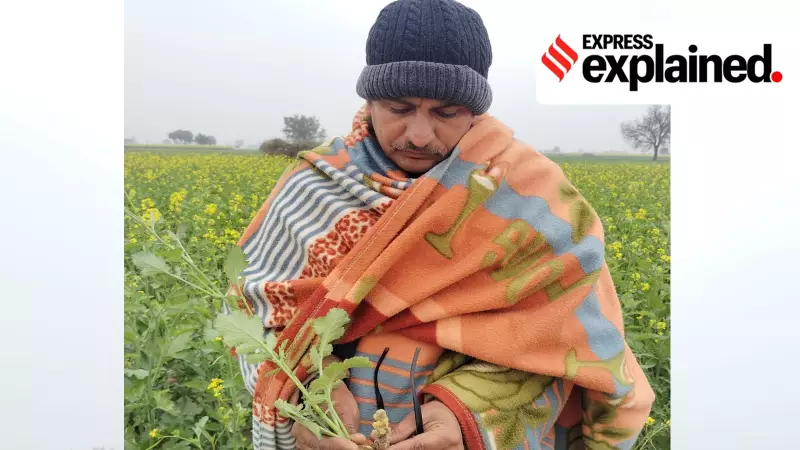
Farmer Kokchand Sahu from Gigorani village in Sirsa district, Haryana, has witnessed this devastation firsthand. "Till three years ago, there was no margoja and my average yield was 9 quintals per acre," he says. In the 2024-25 crop season (October-March), his yield plummeted to a mere 6 quintals per acre, despite following recommended herbicide sprays. This dramatic loss has shattered confidence, leading Sahu to reduce his mustard sowing from 16 acres in 2023-24 to just 6 acres in the current season.

A Growing National Concern for Oilseed Security
The spread of Orobanche poses a direct challenge to India's edible oil security. Mustard is cultivated on nearly nine million hectares across Rajasthan, Uttar Pradesh, Madhya Pradesh, Haryana, and West Bengal. It contributes over 4 million tonnes to India's annual domestic edible oil production of 10.5-10.6 million tonnes.
Reducing the country's heavy reliance on imports—which cost $18.3 billion in 2024-25—hinges on improving mustard yields. Bhagirath Choudhary, director of the South Asia Biotechnology Centre (SABC) in Jodhpur, calls Orobanche the "No. 1 hidden threat" in the region. A survey by SABC in Sirsa and Bhiwani districts of Haryana revealed heavy and uniform emergence of the weed, with higher density in fields repeatedly sown with mustard.
The weed's reproductive strategy makes it a formidable foe. A single shoot produces 40-45 flowers, each containing 4,000-5,000 minute seeds that can remain viable in soil for up to 20 years, creating a persistent seed bank.
The Search for Solutions: Herbicides and Hybrid Seeds
Conventional weed control methods are failing. Broad-spectrum herbicides like glyphosate cannot distinguish between the crop and the parasite. This has spurred the development and adoption of herbicide-tolerant mustard hybrids.
Farmers like Sahu are now testing hybrids like 'Pioneer-45S42CL' from Corteva Agriscience. This hybrid, developed through non-GM methods, tolerates imidazolinone herbicides. When paired with a companion herbicide like 'Kifix' (containing imazapyr and imazapic), it allows farmers to target the Orobanche without harming the mustard plant. A pack for one acre costs around Rs 3,150.
Simultaneously, scientists at Delhi University's Centre for Genetic Manipulation of Crop Plants, led by Deepak Pental, have developed GM mustard lines with genes that confer resistance to multiple herbicides (glyphosate, imidazolinone, and sulfonylurea). This multi-herbicide approach is seen as crucial to prevent the parasite from developing resistance to any single chemical.
The Road Ahead: Science vs. Ideology
The escalating threat from Orobanche, combined with other challenges like aphids and fungal diseases, puts the future of mustard cultivation at a crossroads. The experiences of farmers in Sirsa and beyond highlight an urgent need for effective, science-based solutions.

The debate now centers on whether India's policymakers will permit the cultivation of GM mustard, a decision that could significantly bolster the crop's defense against this parasitic weed. As farmer Sunil Sihag from Shahpuria village notes, the weed now appears within 40 days of sowing even in fertile soil, unlike before when it was seen later and only in sandy soil. The call for a decision grounded in farm economics and scientific evidence, rather than ideology, is growing louder as the mustard belt battles this underground invasion.