Mercedes-Benz India Commits to Luxury Focus Amid Market Competition
German automaker Mercedes-Benz has confirmed its commitment to top-end luxury vehicles in India. The company will not pursue higher sales volumes through entry-level models. This decision comes as Mercedes faces increasing competition in the domestic luxury car market.
Sales Performance and Market Position
Mercedes-Benz India reported a 3% decline in sales for 2025. The company sold 19,007 units during the year. Despite this decrease, Mercedes maintained its position as the largest seller of luxury cars priced above ₹50 lakh. This marks a decade-long leadership run for the brand in India's premium automotive segment.
Meanwhile, German competitor BMW showed strong growth. BMW India sales increased by 14% to reach 18,001 units in 2025. This performance significantly narrowed the gap between the two automotive giants in the Indian market.

Strategic Differences Between Mercedes and BMW
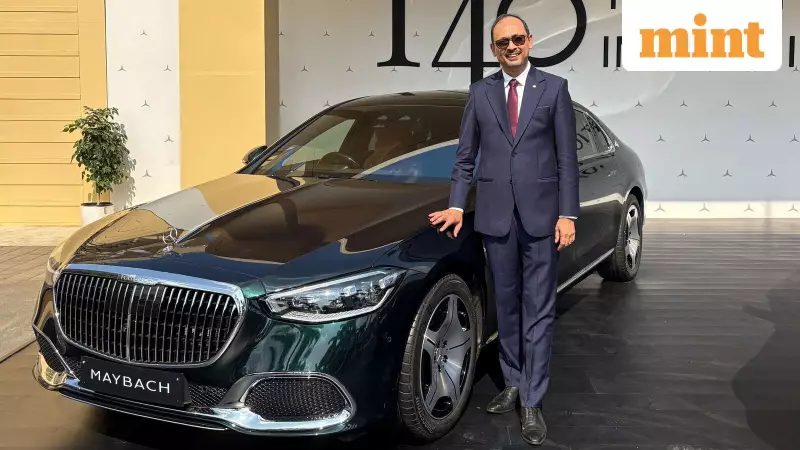
Santosh Iyer, Managing Director and CEO of Mercedes-Benz India, explained the company's approach. "We will not join the race to sell more entry-level luxury cars simply to chase volumes," Iyer stated in a recent interview. He emphasized that Mercedes has maintained this strategy for fourteen years despite market fluctuations.
Iyer acknowledged that Mercedes participates in the entry-level segment. However, aggressive discounting by competitors has discouraged the company from engaging in price wars. "The biggest impact of price wars is the residual value impact and brand dilution," Iyer noted. "Many brands have experienced this in the Indian market."
BMW India follows a different strategy. The company aims to expand the luxury market by attracting first-time buyers. These customers typically upgrade from cars priced between ₹15 lakh and ₹25 lakh. BMW India CEO Hardeep Singh Brar explained, "We are actually playing the role of expanding the pie of the luxury market, because somebody has to play that role."
Mercedes Customer Base and Growth Drivers
Mercedes-Benz India draws its strength from a distinct customer segment. Approximately 60% of Mercedes sales come from luxury dwellers who own multiple luxury vehicles. The company has also observed many first-time buyers directly entering the core luxury segment rather than starting with entry-level models.
Iyer expressed skepticism about market expansion through aggressive pricing. "Gaining market share through aggressive pricing will not expand the market," he argued. "It eventually requires offering value products and retaining brand value."
The Mercedes executive described such approaches as short-term strategies. "If it were growing the market, then I would be a big fan of it," Iyer said. "But if it is only taking share, it's a short-term story, and we would like to stay out of it for many years."
Despite the sales decline, Mercedes India achieved its best-ever year in terms of revenue during 2025. This success demonstrates the effectiveness of their premium-focused strategy.
Future Plans and Market Outlook
Both automotive giants have ambitious plans for the Indian market. BMW India intends to launch 25 new models in 2026. The company will place strong emphasis on entry-level luxury vehicles. Currently, about half of BMW's sales come from first-time buyers who previously did not own luxury vehicles.
Mercedes-Benz India plans to introduce 12 new products during the same period. These launches will include both electric vehicles and internal combustion engine models. The company remains optimistic about growth prospects for 2026.
Iyer pointed to several positive indicators for the luxury car market. "If I look at the number of people inquiring for a luxury car, it's only going up year on year," he observed. "So aspiration is there."
The Mercedes executive acknowledged that geopolitical uncertainties and market fluctuations can temporarily affect demand. However, he expressed confidence in the market's underlying strength. "When there is uncertainty, there is maybe a postponement of demand," Iyer noted. "But if the uncertainty goes away geopolitically, FTAs come in, the market is buoyant, capital markets are strong, you will find absolutely strong animal sentiment coming back even stronger."

Both Mercedes and BMW anticipate growth in India's luxury car market for 2026. They cite an expanding economy, lower interest rates, and increasing affluence as key drivers. The competition between these automotive leaders promises to intensify as they pursue different strategies in India's evolving premium car segment.