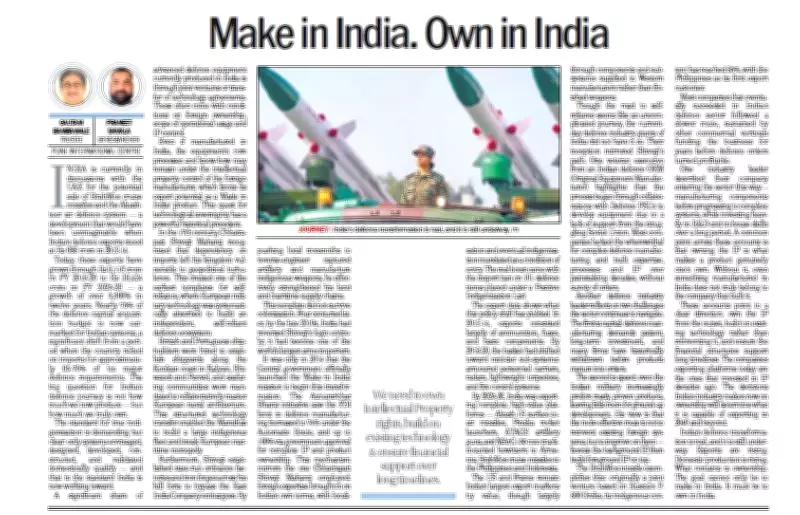
The 'Make in India, Own in India' initiative represents a strategic shift towards economic self-reliance, emphasizing domestic production and ownership in key sectors. This policy, highlighted in a recent commentary, aims to reduce dependence on imports and strengthen national security.
Key Sectors Targeted
The initiative focuses on defense, electronics, and critical technologies. According to the commentary, India aims to achieve self-sufficiency in defense manufacturing by 2027, with a target of exporting $5 billion in defense equipment annually. In electronics, the government has set a goal of producing $300 billion worth of electronics by 2026, including mobile phones and semiconductor chips.
Policy Measures
To promote 'Own in India', the government has introduced production-linked incentives (PLI) schemes worth ₹2 lakh crore across 14 sectors. Additionally, the policy encourages intellectual property (IP) creation and ownership within India. The commentary notes that 'ownership of technology and design is as important as manufacturing'. This includes promoting Indian patents and trademarks.

Impact on Trade and Economy
The initiative is expected to reduce India's trade deficit, which stood at $190 billion in 2025-26. By substituting imports with domestic products, India aims to save foreign exchange and create jobs. The commentary cites that the electronics manufacturing sector alone could create 25 million jobs by 2030.
Challenges and Criticism
Critics argue that the policy may lead to inefficiencies and higher costs in the short term. However, proponents believe that long-term benefits outweigh initial hurdles. The commentary emphasizes the need for 'a calibrated approach' to avoid supply chain disruptions.
Strategic Autonomy
Ultimately, 'Make in India, Own in India' is about strategic autonomy. As the commentary states, 'self-reliance is not about isolation but about building capabilities to withstand global shocks'. This aligns with India's goal of becoming a developed nation by 2047.