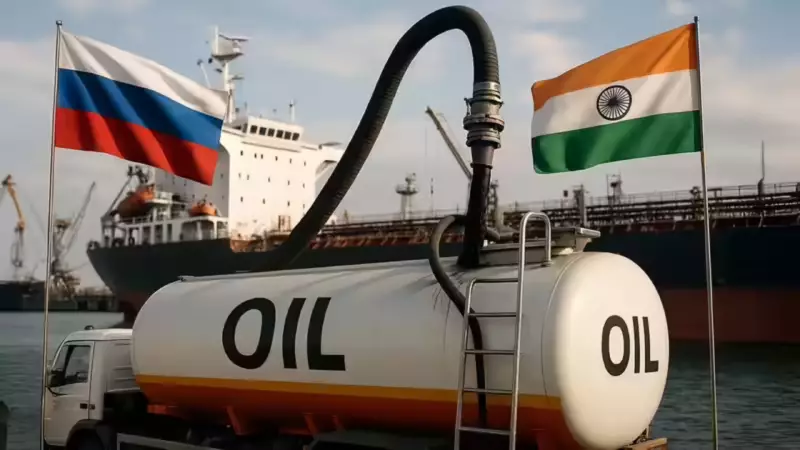
India witnessed a significant 29% month-on-month decline in Russian crude oil imports during December. This drop pushed volumes to their lowest point since the implementation of the international price cap policy. The Centre for Research on Energy and Clean Air (CREA) highlighted this trend in its latest monthly analysis of Russian fossil fuel exports.
Sharp Decline Despite Overall Import Growth
The report reveals a surprising contradiction. India's total crude imports grew marginally in December, yet purchases from Russia fell sharply. This specific decline was primarily driven by two major players in the refining sector.
Refinery-Specific Cuts Drive the Drop
Reliance Industries' massive Jamnagar refinery slashed its Russian crude intake by nearly 49% in December. Simultaneously, India's state-owned refineries collectively reduced their imports from Russia by 15%. These substantial cuts created the overall downturn.

According to data from Kpler, a global analytics firm, India imported over 20.4 million barrels of Russian crude throughout 2025. The monthly figure for December stood at 1.2 million barrels. This marked a clear drop from the 1.8 million barrels imported in November.
January Shows a Promising Rebound
The story takes a positive turn for January. Data indicates a strong recovery is already underway. By January 13th of this year, India had imported over 1.1 million barrels of Russian crude oil. This suggests a rapid rebound from December's low point.
India's Position in Global Russian Fuel Purchases
In terms of value, India ranked as the third-highest buyer of Russian fossil fuels in December. Turkey displaced India from the second position. India's total import bill for Russian hydrocarbons reached EUR 2.3 billion for the month.
Crude oil dominated India's purchases, constituting 78% of the total value at EUR 1.8 billion. The remaining imports consisted of coal, valued at EUR 424 million, and oil products, worth EUR 82 million.
For comparison, India's crude oil import value from Russia was recorded at EUR 2.5 billion in October and EUR 2.6 billion in November.
Details on Refinery Import Cuts
The CREA report provided specific details on the refinery cuts. It confirmed the Jamnagar refinery reduced its Russian imports by almost half in December. Notably, all these imports were supplied by Russian company Rosneft. However, these were from cargoes purchased before recent US sanctions from the Office of Foreign Assets Control (OFAC) took effect.
The report reiterated the 15% cut by state-owned refineries, aligning with the broader national trend.
Broader Context of Russian Fossil Fuel Exports
The analysis placed India's activity within a global context. Russia's overall monthly fossil fuel export revenues experienced a marginal 2% month-on-month decline in December. This brought daily revenues to approximately EUR 500 million, the second-lowest figure since the full-scale invasion of Ukraine.
Monthly export volumes saw a similar 2% reduction. Specifically, Russia's crude oil export revenues dropped by 12% to EUR 198 million per day.
Concentrated Global Market for Russian Fuels
Russia's fossil fuel exports remain highly concentrated among a few key buyers. China dominates purchases of coal and crude oil. Turkey leads in buying oil products. The European Union persists as the largest buyer of Russian liquefied natural gas (LNG) and pipeline gas.
In December, China maintained its position as the largest global buyer of Russian fossil fuels. It accounted for 48% of Russia's export revenues from its top five importers, a sum totaling EUR 6 billion. The EU ranked as the fourth-largest buyer, accounting for 11% or EUR 1.3 billion of those revenues.
Refined Product Exports to Sanctioning Countries
The report highlighted an interesting supply chain detail. In December, five refineries located in India, Turkey, and Brunei processed Russian crude. These facilities then exported oil products worth EUR 943 million to countries that have imposed sanctions on Russia.
The importers of these refined products included the European Union (EUR 436 million), the United States (EUR 189 million), the United Kingdom (EUR 34 million), and Australia (EUR 283 million).