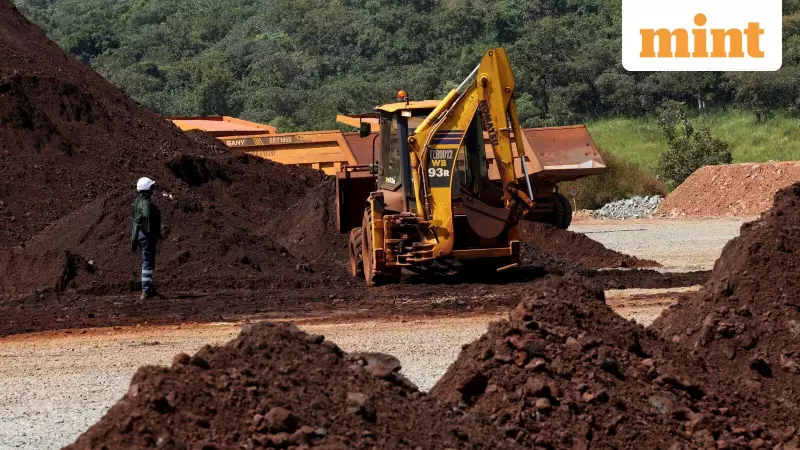
India's steel industry is witnessing a significant shift in its raw material sourcing strategy, with iron ore imports reaching their highest level in seven years during the calendar year 2025. The country imported a substantial 12.2 million tonnes of iron ore, which is nearly double the volume recorded in the previous year, according to data from the commodities market intelligence firm Big Mint.
Drivers Behind the Import Surge
The sharp increase in overseas purchases is attributed to a confluence of global and domestic factors. A primary reason is a global glut of high-grade iron ore, which has kept international prices soft. At the start of 2025, prices were below $100 per tonne, creating an attractive arbitrage opportunity for Indian steelmakers.
On the domestic front, specific supply constraints played a major role. JSW Steel emerged as the largest importer, accounting for nearly 80% of the total imports. This was largely due to the company surrendering its Jajang mines in Odisha in 2025, which led to a drop in its domestic production. To bridge this gap, the company turned to international markets, primarily sourcing from Brazil and Oman.

Experts like Dhruv Goel, CEO of Big Mint, also point to logistical challenges and high transport costs within India, which made it difficult and expensive to move pellets from central regions to western India. This forced steel plants on the west coast to import ore from the Middle East.
A Structural Quality Crunch and Capacity Mismatch
Beyond immediate pricing and supply issues, analysts highlight a deeper, structural problem: the deteriorating quality of domestically available iron ore. While India has ample reserves, the proportion of high-grade ore suitable for efficient steelmaking is tightening.
This domestic quality issue coincides with a rise in global availability of premium ore. Major new projects like the Simandou mega-mines in Guinea, expansions in Australia, and Vale's Northern Mines have flooded the market with high-grade supply, keeping international prices competitive.
The situation has created a worrying mismatch. India's steel production capacity grew by 9.5% to 163 million tonnes in 2025, while domestic iron ore output increased by only 4% to 295 million tonnes. The availability of usable, high-grade ore has not kept pace with the expanding steelmaking capacity.
Policy Hurdles and Future Outlook
The trend raises concerns about long-term raw material security for a nation with ambitious targets under its National Steel Policy. Although the government has discussed measures like reallocating non-operational mines, capping auction premiums, and levying export taxes, resistance from states and companies has stalled progress.
Looking ahead, experts expect imports to remain elevated in the near term. Niladri N Bhattacharjee of Grant Thornton Bharat notes that the superior quality of imported ore makes it economically viable, especially for coastal plants. However, as new domestic mines auctioned in recent years gradually become operational, the supply dynamics may slowly correct.
Not all analysts view the import spike as a sign of permanent scarcity. Suman Kumar of Philip Capital argues that there is no fundamental shortage of iron ore in India and that the surge is purely a pricing phenomenon. He expects domestic availability to improve as mid-sized mining players ramp up their production.
Nevertheless, the record imports in 2025 serve as a clear signal that India's steel growth story must be underpinned by a more robust and high-quality domestic iron ore supply chain to ensure its competitive edge and strategic autonomy.