India's Maritime Lifeline: The Container Conundrum
Along the bustling coastline of Gujarat, a silent ballet of commerce unfolds daily. Thousands of steel containers, painted in grids of vibrant red, deep blue, and weathered rust-brown, move with precise choreography. These metal boxes are far more than simple cargo holders; they are the vital arteries connecting India's industrial heartland to global markets.
The Pulse of Global Trade
Operating relentlessly 365 days a year, towering cranes at Gujarat's ports load and unload these containers—some measuring 20 feet, others 40 feet—onto massive ships that traverse the world's oceans. This constant flow keeps the wheels of international commerce turning. The disruption of even a single container ship can trigger cascading effects: pharmacy shelves may empty of life-saving medications, factories could halt production awaiting crucial components, and consumers might face shortages of imported goods.
Gujarat serves as India's primary maritime gateway, handling approximately 50% of the nation's sea-borne cargo. Major ports including the privately-operated Mundra (Adani Group), government-managed Kandla, and APM Group's Pipavav facility process the lion's share of container traffic. Despite this critical role, India remains startlingly dependent on imported containers, with China supplying nearly 90% of the country's needs.

A Strategic Response to Structural Vulnerability
To address this strategic weakness, Union Finance Minister Nirmala Sitharaman has announced the Container Manufacturing Assistance Scheme (CMAS)—a comprehensive five-year, Rs 10,000 crore initiative. This ambitious program aims to cultivate a globally competitive, self-reliant container manufacturing ecosystem within India.
Ambitious Targets and Economic Impact
The scheme targets an annual domestic production capacity of 1 million TEUs (Twenty-foot Equivalent Units). Beyond reducing import dependence, this industrial push is projected to generate substantial employment, supporting approximately 3,000 direct jobs and over 50,000 indirect positions across related sectors.
This policy intervention responds directly to vulnerabilities exposed during the post-pandemic trade recovery. When global commerce rebounded, Indian exporters confronted an acute container shortage that sent freight rates soaring and caused significant shipment delays. The crisis laid bare India's overwhelming reliance on China, which currently manufactures over 95% of the world's shipping containers, effectively maintaining a near-monopoly in this critical segment.
Gujarat's Natural Advantages and Historical Context
Within India's industrial landscape, Gujarat emerges as the natural focal point for this renewed manufacturing push. The state boasts two of the country's largest commercial ports—Mundra and Kandla—coupled with a long-established reputation as a manufacturing powerhouse. Gujarat processes a substantial portion of India's total cargo throughput and maintains strong capabilities in steel processing, fabrication, engineering, and export-oriented industries—all essential inputs for container production.
This represents a second opportunity for the state. Following the initial COVID-19 disruptions, several Gujarat-based companies from Ahmedabad, Bhavnagar, Kutch, and Rajkot ventured into container manufacturing, encouraged by government support and evident supply gaps. The rationale appeared sound: rising exports, proximity to ports, and the potential for import substitution. However, this first wave encountered harsh commercial realities that ultimately limited its success.
The Core Challenge: Cost Competitiveness
The fundamental obstacle has been achieving price parity with Chinese manufacturers. Chinese producers operate at enormous scale, supported by integrated supply chains and consistent global demand. Indian entrants, by contrast, were building operations from scratch without assured volumes or ecosystem support.

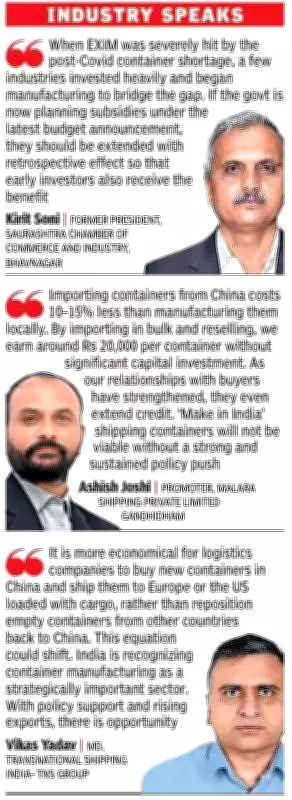
Malara Shipping Pvt Ltd, based in Gandhidham, eventually suspended manufacturing after failing to compete with Chinese pricing. The company has since partnered with a Chinese supplier, importing and reselling containers in the domestic market. Similarly, Rajkot-based Jubilant Containers manufactured approximately 2,000 specialized containers for international shipping lines in 2023, but found the pricing gap unsustainable. Production costs ranged between $2,500-$2,600 per container, while comparable Chinese units were available for approximately $1,700. The company ultimately shifted focus to domestic buyers.
The Steel Dilemma and Ecosystem Requirements
At the heart of this cost disadvantage lies a fundamental material challenge: steel constitutes nearly 60% of a container's total cost. Approximately three-quarters of this steel requirement is corten steel—a specialized corrosion-resistant grade essential for maritime applications. Manufacturers require specific grades and dimensions that meet stringent global standards.
Indian steel producers typically demand bulk orders for producing these specialized sizes, volumes that smaller container manufacturers cannot easily absorb. These specific dimensions are not readily stocked and require advance orders. While importing corten steel from China remains technically possible, this approach negates cost advantages and undermines the goal of establishing a fully indigenous value chain.
Industry experts emphasize that sustainable success requires more than financial subsidies. A coordinated ecosystem approach is essential, including:
- Reliable access to corten steel at viable prices
- Cluster-based industrial development
- Shared testing facilities and technology partnerships
- Comprehensive export support mechanisms
Without these structural enablers, scaling production to globally competitive standards remains exceptionally challenging in this capital-intensive, margin-sensitive industry.
Prospects and Implications for India's Industrial Future
For Gujarat, the finance minister's policy reset presents a significant opportunity to leverage its port connectivity, industrial depth, and entrepreneurial capacity to position itself as India's container manufacturing hub. The coming phase will determine whether India can translate budgetary intent into sustained industrial capability.
If raw material constraints, financing gaps, and scale challenges can be effectively addressed, Gujarat stands poised to leverage its maritime strengths and manufacturing base to capture meaningful market share in a segment long dominated by China. If these structural issues remain unresolved, the renewed push risks repeating the experience of the first wave—where high ambitions were ultimately tempered by hard economic realities.
The success of this initiative carries implications far beyond container manufacturing itself. It represents a critical test case for India's broader industrial strategy, demonstrating whether targeted policy interventions can overcome entrenched global supply chain advantages and establish competitive domestic manufacturing ecosystems in strategically important sectors.