Massive Infrastructure Investment Required for Hyderabad's Future Growth
The Telangana government faces a monumental infrastructure challenge, with estimates suggesting it may need to invest nearly Rs 4 lakh crore in transport and mobility infrastructure across the Hyderabad Metropolitan Region by 2050. This staggering investment is deemed necessary to support the city's rapid expansion and accommodate its rising travel demands as Hyderabad continues its transformation into a major metropolitan hub.
Comprehensive Mobility Plan Reveals Detailed Projections
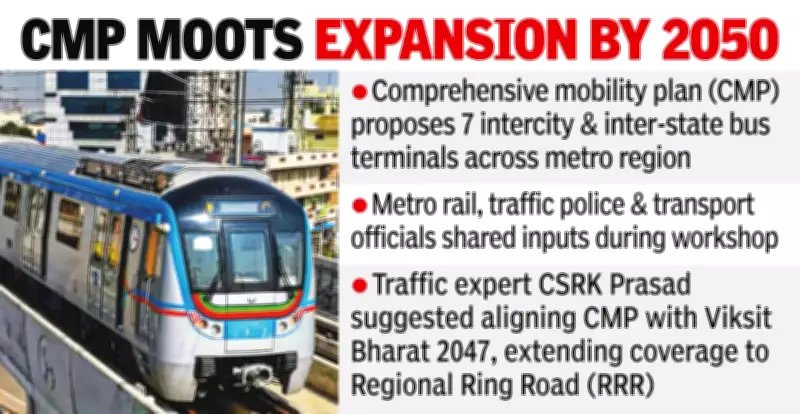
The eye-opening estimate was presented during a workshop organized by the Hyderabad Metropolitan Development Authority as part of the preparation of the comprehensive mobility plan. This crucial document will feed directly into the metropolitan region's master plan for 2050, shaping the city's development trajectory for the next quarter-century.
The detailed proposals were submitted by LEA Associates South Asia, the consulting firm tasked with preparing the comprehensive mobility plan. Their analysis provides a roadmap for Hyderabad's transportation evolution, with particular emphasis on creating a sustainable, efficient, and accessible mobility network.

Rail-Based Public Transport Expansion Takes Center Stage
A major component of the ambitious plan focuses on dramatically expanding Hyderabad's rail-based public transport network. According to the comprehensive presentation, the cumulative length of additional metro rail corridors required is projected to reach 258 kilometers by 2030. This expansion would continue aggressively, growing to 534 kilometers by 2040 and eventually reaching approximately 556 kilometers by 2050.
The proposed corridors are designed as twin-track lines, with one track operating in each direction to maximize efficiency and capacity. This rail expansion represents a fundamental shift toward mass transit solutions that can move large numbers of people efficiently while reducing congestion and environmental impact.
Multi-Modal Transport System Growth Projections
The suburban rail network under Hyderabad's multi-modal transport system is also expected to experience significant growth according to the comprehensive mobility plan. The additional MMTS network required for the city is estimated at 202 kilometers by 2030 and 255 kilometers by 2040, eventually extending to 336 kilometers by 2050.
This expansion of the suburban rail system would create vital connections between Hyderabad's core urban areas and its expanding periphery, facilitating easier commutes for residents while supporting balanced regional development.
Road and Highway Network Enhancements Detailed
The comprehensive mobility plan also addresses Hyderabad's road infrastructure needs with specific projections. The road and highway network, which includes higher order road transport networks, arterial corridors, and sub-arterial corridors with right of way greater than 18 meters, is proposed in addition to the existing road network.
For the years 2030, 2040, and 2050, the required road network expansion would be 223 kilometers, 2,640 kilometers, and 2,847 kilometers respectively. In terms of lane-kilometers, the road network supply increase for these same years would be 759 lane-kilometers, 11,070 lane-kilometers, and 19,352 lane-kilometers respectively.
MP Raju, managing director of LEA Associates, emphasized the scale of the challenge while presenting these recommendations. "The projections reflect both Hyderabad's current growth trajectory and the infrastructure necessary to support sustainable urban development," he explained during the workshop presentation.
Strategic Planning for Sustainable Urban Mobility
The comprehensive mobility plan represents more than just infrastructure projections—it embodies a strategic approach to urban planning that integrates transportation with broader development goals. By anticipating future needs and planning accordingly, Hyderabad aims to avoid the congestion and mobility challenges that have plagued other rapidly growing cities.

The proposed investments would transform Hyderabad's transportation landscape, creating a truly multi-modal system where metro rail, suburban rail, and enhanced road networks work together seamlessly. This integrated approach is designed to provide residents with multiple transportation options while reducing reliance on private vehicles.
As Hyderabad continues its remarkable growth story, these transportation investments will play a crucial role in determining the city's quality of life, economic competitiveness, and environmental sustainability for decades to come.