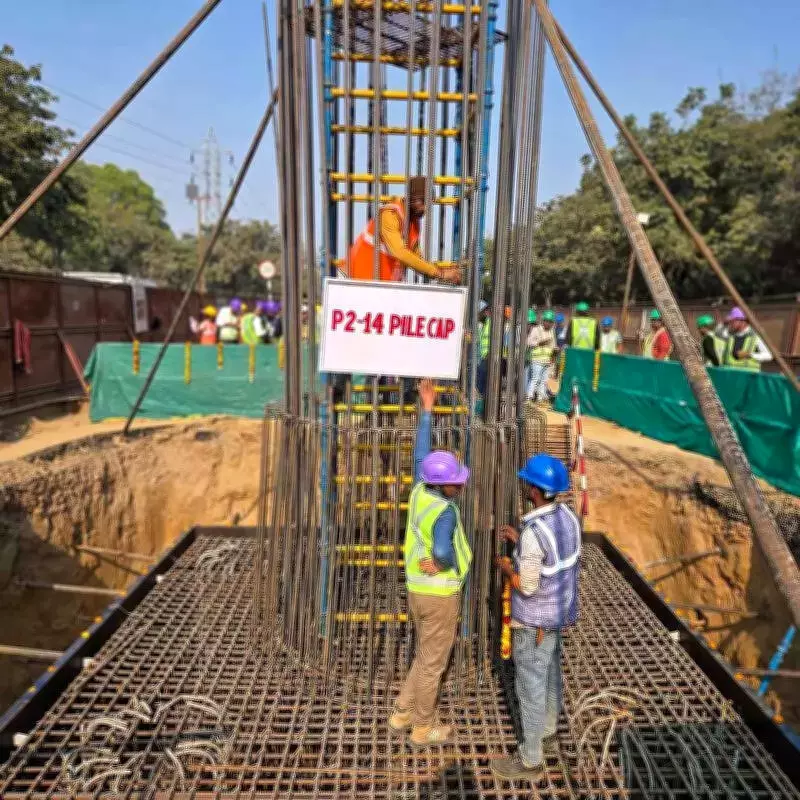
Gurgaon Metro Phase 1 Construction Accelerates with Commencement of Pile Cap Work
The construction of the first phase of Gurgaon's new metro line has gathered significant pace as pile cap work officially started on Tuesday near the proposed Cyber Park station. This crucial development marks a visible shift in the project's progress, with on-ground structural activity now set to become increasingly apparent along the entire corridor, according to officials from the Gurugram Metro Rail Limited (GMRL).
Project Overview and Strategic Importance
The ambitious 15.3-kilometer Phase 1 corridor is designed to seamlessly connect Millennium City Centre to Sector 9, strategically passing through the city's most vital residential, commercial, and corporate hubs. This elevated metro line is poised to revolutionize urban mobility in Gurgaon, alleviating traffic congestion and providing a reliable public transportation alternative for thousands of daily commuters.
With the pile cap work now underway, officials have confirmed that the construction of piers—the essential vertical columns that will support the elevated viaduct—will commence in a phased manner along the alignment. In total, over 700 pile caps will be constructed underground as part of Phase 1, forming the robust foundation necessary for the metro's infrastructure.

Technical Details and Construction Methodology
GMRL initiated the piling work in November of last year, laying the groundwork for the current phase. "After successfully completing the piling at designated locations, we have now commenced casting pile caps near the proposed Cyber Park station. This milestone signifies the beginning of the substructure for the elevated corridor," explained a senior GMRL official.
A pile cap is essentially a thick concrete slab that rests atop a cluster of piles. These piles are deep cylindrical structures drilled into the ground to transfer the substantial load of the metro viaduct to stable soil strata beneath the surface. The primary function of the pile cap is to bind these individual piles together and distribute the load evenly, thereby creating a formidable foundation base for each pier.
The construction sequence involves casting the pile cap and allowing it to gain sufficient strength. Subsequently, the pier shaft is erected above it, followed by the installation of the pier head. Ultimately, girders that support the tracks will be launched, completing the superstructure. Officials emphasized that with pile cap casting now in progress, residents can expect to witness pier construction activities intensifying across various sites along the corridor in the coming weeks.
Contractual Framework and Future Integration
In August last year, the contract for constructing Phase 1 was awarded to Dilip Buildcon Ltd and Ranjit Buildcon Ltd for a substantial sum of Rs 1,277 crore. The entire project is projected to be completed within a timeframe of 30 months, underscoring the urgency and scale of this infrastructure initiative.
Phase 1 will feature several strategic interchanges designed to enhance multimodal connectivity. These include interchanges at Millennium City Centre with the existing Yellow Line, at Subhash Chowk with the proposed Bhondsi metro line, at Hero Honda Chowk with the Regional Rapid Transit System (RRTS) corridors, and at Sector 10 with the bus terminal-cum-depot. Additionally, an underpass at Bakhtawar Chowk is planned to facilitate smoother traffic flow and pedestrian safety.
The Gurgaon Metro project represents a transformative leap in the city's urban infrastructure, promising to redefine daily commutes and bolster economic growth by improving accessibility to key business districts and residential areas.