Office Wall Colors Could Be Draining Your Energy Throughout the Day
It is 3 pm, and your brain feels foggy while your eyes grow heavy. While many attribute this afternoon slump to poor sleep or demanding workloads, the color of your office walls might be quietly sapping your energy all day long. According to experts, the solution lies in understanding the "Green-Refractory Period," a phenomenon where our eyes process green wavelengths with minimal muscular effort.
Scientific Evidence Supporting Green Environments
A 2026 study published in the journal Applied Ergonomics found that "Green-dominant visual environments were associated with lower levels of visual fatigue and reduced accommodative strain compared to high-brightness or blue-dominant backgrounds." This research confirms that green tones significantly reduce eye strain during screen-based work, supporting the foundational concept behind the "Green-Refractory" theory of lower visual effort.
In an exclusive interview with the Times of India, Dr. Eleni Nicolaou, Art Therapist and Creative Wellness Expert at Davincified, explained, "The human eye can focus on green with the least amount of strain, providing passive rest for the optic nerve while we work." This insight highlights why muted greens could transform your workday and serve as an effective antidote to the notorious "3 pm burnout" phenomenon.

Combating Digital Eye Strain with Strategic Color Choices
Cool blues and stark whites have long dominated office design aesthetics, but these colors may actually be working against employee wellbeing. While blue is traditionally considered calming, when paired with digital screens it can contribute significantly to digital eye strain. White walls reflect blue light emitted from monitors, effectively doubling the glare that your eyes must process throughout the workday.
"Muted greens absorb light rather than reflect it," emphasized Dr. Nicolaou. "This reduces the contrast between your monitor and the background, preventing what we call 'visual fatigue'—that heavy, strained feeling in your eyes by mid-afternoon." The reduced contrast means your eyes don't constantly readjust between bright screens and surrounding walls, preserving mental energy for actual work rather than burning it on visual processing tasks.
The Biophilic Anchor: Psychological Benefits of Green Tones
There exists a profound psychological reason why "leaf-tones" feel inherently calming to humans. Our brains associate these shades with safety, abundance, and environments where resources are plentiful and threats remain minimal. "Being surrounded by forest green lowers heart rate and cortisol levels," Dr. Nicolaou elaborated. "It keeps the fight-or-flight response at bay during high-stress meetings or tight deadlines. Your nervous system interprets these colors as signals that you're in a safe, nourishing environment."
A separate 2026 study published in Building and Environment revealed that "Exposure to green hues and nature-associated colors in indoor environments significantly reduced stress markers, including heart rate and cortisol levels." This research validates claims that green environments calm the nervous system and supports the "biophilic anchor" argument—the deep evolutionary connection humans have with natural colors.
Balancing Creativity and Productivity with Different Greens
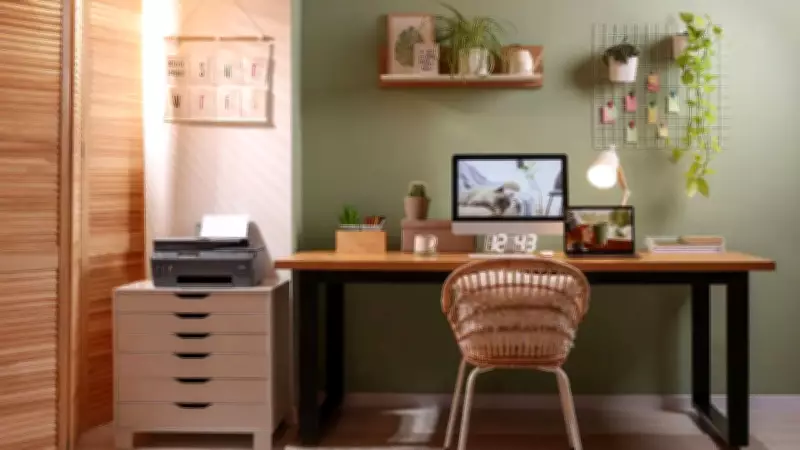
Not all green shades serve identical purposes in workplace environments. Sage green promotes high-level creative thinking, making it ideal for brainstorming sessions or strategic planning meetings. Forest green, by contrast, encourages deep, concentrated "flow" states where complex tasks feel more manageable and focused attention becomes sustainable.
Authors of a 2025 Journal of Environmental Psychology study, widely cited in 2026 workplace research, noted that "Natural color palettes, particularly greens, enhanced sustained attention and task performance compared to neutral or high-contrast environments." This research asserts that green improves both focus and productivity while reinforcing the distinct differences between calming versus stimulating color environments.

"If your work requires sustained analytical thinking, forest green provides the grounding you need," advised Dr. Nicolaou. "For creative professionals who need to generate innovative ideas, sage offers the lightness that sparks inspiration and creative breakthroughs."
The Importance of Paint Finish and Light Reflectance
Paint finish matters as much as color selection when optimizing office environments. "Opt for a chalky matte finish for home offices," recommended Dr. Nicolaou. "Any gloss or satin sheen on dark green creates 'specular reflection,' or hot spots of light that force your eyes to readjust constantly. This defeats the entire purpose of choosing a calming color. A matte finish with a low Light Reflectance Value absorbs light evenly, maintaining the visual rest your eyes need throughout the day."
The 2026 workplace wellbeing insights from the World Green Building Council established that incorporating natural colors like green in offices "supports visual comfort, wellbeing and sustained productivity." Dr. Nicolaou concluded, "The connection between our environment and mental state is profound. Green is not only aesthetically pleasing but neurologically restorative as well. When we surround ourselves with these tones, we're giving our visual system a break from the constant strain of modern screen work. Small changes, like paint color and finish, can have measurable effects on our daily energy levels—creating workspaces that support sustained focus rather than depleting it hour by hour."