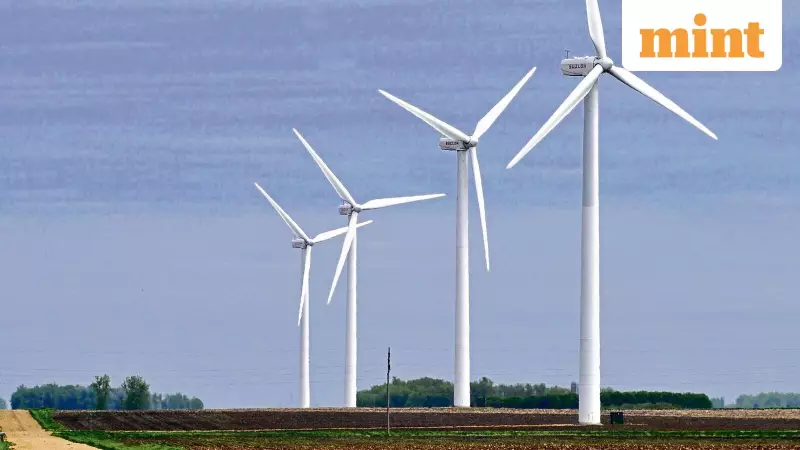
The Indian government is crafting a comprehensive new strategy to breathe fresh life into the country's wind energy sector, which has faced significant headwinds in recent years. A dedicated task force will address long-standing challenges like grid connectivity, land acquisition, and stalled power purchase agreements to propel India towards its ambitious target of 100 gigawatts (GW) of wind power capacity by 2030.
Addressing Core Challenges for a Wind Revival
According to sources familiar with the development, the Union government's blueprint will tackle a host of persistent issues. These include the lack of adequate grid infrastructure, difficulties in acquiring land, a backlog of unsigned power purchase agreements (PPAs), and poor scheduling and forecasting of wind energy. Additionally, the plan aims to improve coordination between state governments and ensure distribution companies actively procure renewable power.
A critical component of the revival plan is repowering – modifying and replacing older, less efficient wind turbines with modern, higher-capacity models to boost output from existing sites. This initiative comes at a crucial time, as India's current wind capacity stands at 53 GW, accounting for just 10.5% of the nation's total installed power generation capacity of 505 GW.

Task Force to Chart the Roadmap
The Ministry of New and Renewable Energy (MNRE) has moved to establish a task force comprising officials from the MNRE, the Power Ministry, and representatives from the wind energy industry. This group will be responsible for preparing a detailed revival roadmap. The move follows a meeting on 12 December where the ministry engaged with wind sector developers and EPC companies to discuss the task force's potential terms of reference.
Industry participants at the meeting suggested creating a dedicated web portal to track the progress of wind projects, including regulatory approvals and implementation status. "Grid issues, land acquisition and coordination with the state governments have emerged as the key issues which the task force would look at," one source stated, noting that the final terms are still being deliberated.
The scale of the challenge is substantial. Reports indicate that wind energy projects worth an estimated ₹60,000 crore are currently stalled. These form a significant part of the 43 GW of renewable energy capacity across technologies that are awaiting signed PPAs.
Environmental and Logistical Hurdles
Beyond logistical and financial barriers, the sector also contends with environmental concerns. The protection of the Great Indian Bustard, an endangered bird species, has led to delays in approving transmission and renewable projects in key states like Rajasthan and Gujarat since 2021. The low-flying birds are at risk of collision with wind turbine blades and power lines.
Experts highlight that the shift to a reverse bidding model for projects and the complex process of acquiring multiple land parcels from different owners have been major roadblocks. "There is a requirement for several patches of land involving different landowners, which is a major roadblock," explained MP Ramesh, former director-general at the National Institute of Wind Energy.
Amit Kumar of Grant Thornton added that developers often face a catch-22, acquiring land only to find the project is unfeasible due to a lack of grid connectivity. He emphasized the need to re-energize the sector and boost the domestic manufacturing of critical components like magnets to enhance competitiveness.
At the Global Wind Day conference in June, MNRE Minister Pralhad Joshi underscored the need for a coordinated national push. He highlighted plans to expand wind power into new states like Madhya Pradesh, Telangana, and Odisha, and to launch the offshore wind sector with 4 GW of identified areas off the coasts of Gujarat and Tamil Nadu. The government is also focusing on integrating wind into round-the-clock power through storage solutions and investing in AI-based forecasting to better manage this variable energy source.