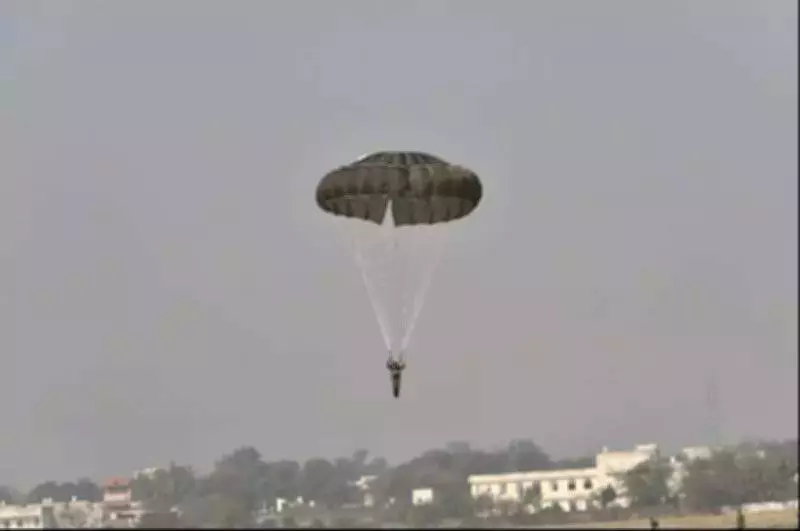
Gliders India Unveils Advanced Parachute System for High-Altitude Operations
In a significant boost to India's defense capabilities, Kanpur-based Gliders India Limited (GIL) has successfully manufactured an advanced parachute system specifically designed for operations in higher altitude drop zones. This development marks a pivotal step in strengthening the nation's airborne operational readiness, particularly for challenging terrains and specialized missions.
Collaborative Development with ADRDE
The innovative parachute system was developed in close collaboration with the Agra-based design partner, the Aerial Delivery Research and Development Establishment (ADRDE). This partnership has engineered a system that significantly enhances paratrooper performance by enabling higher deployment velocities and altitudes, all while maintaining stringent safety and reliability standards.
A GIL official highlighted the system's key features, stating, "A standout aspect is its ability to withstand deployment speeds of up to 400 kmph while keeping shock levels within permissible limits. It is suitable for both normal and high-altitude drop zones and comes equipped with main and reserve parachutes integrated with an automatic activation device, ensuring an additional layer of safety."

Operational Capabilities and Specifications
This advanced system supports drops up to an impressive 16,404 feet above mean sea level, making it particularly effective for mountainous terrain and specialized airborne operations. Its multiple modes of deployment provide exceptional flexibility across a wide operational altitude range, allowing for adaptable mission planning in diverse environments.
Successful Trials and Certification
The system's development culminated in rigorous testing and certification processes. Two parachute systems, inspected by the Directorate General of Quality Assurance (DGAQA) and certified by the Centre for Military Airworthiness & Certification (Regional Centre for Military Airworthiness, Kanpur), underwent their first live jumps on February 20 at the Malpura drop zone in Agra.
The official added, "The trials were conducted in the presence of the ADRDE project team, representatives from GIL and DGAQA Kanpur, and officials of the Indian Air Force."
These jumps were executed by Chief Test Jumper, Wing Commander Rahul Jha, and Test Jumper, Master Warrant Officer R J Singh from ADRDE, who carried out the high-altitude mode jumps, demonstrating the system's robustness and reliability in real-world conditions.
Implications for National Security
This advancement not only showcases India's growing prowess in defense manufacturing but also enhances the operational effectiveness of airborne forces. By enabling safer and more efficient high-altitude deployments, the system is set to play a crucial role in future military operations, particularly in challenging landscapes like the Himalayas.
The successful development and testing of this parachute system underscore a collaborative effort between industry and defense research, paving the way for further innovations in India's defense sector and reinforcing the nation's strategic capabilities on the global stage.