India's leading electric bus manufacturers are preparing to bid aggressively for a major government tender, seeking to supply 6,230 electric buses across five metropolitan cities. The tender, cumulatively valued at over ₹6,000 crore, represents a significant push in the nation's public transport electrification drive.
Details of the Mega Tender and City-Wise Allocation
The tender documents, released on 9 January 2026 by Convergence Energy Services Ltd (CESL), outline the ambitious plan. The submission window for bids opened on the same day and will remain active until 10 March 2026. The electric buses are slated for deployment in Delhi, Mumbai, Pune, Ahmedabad, and Hyderabad.
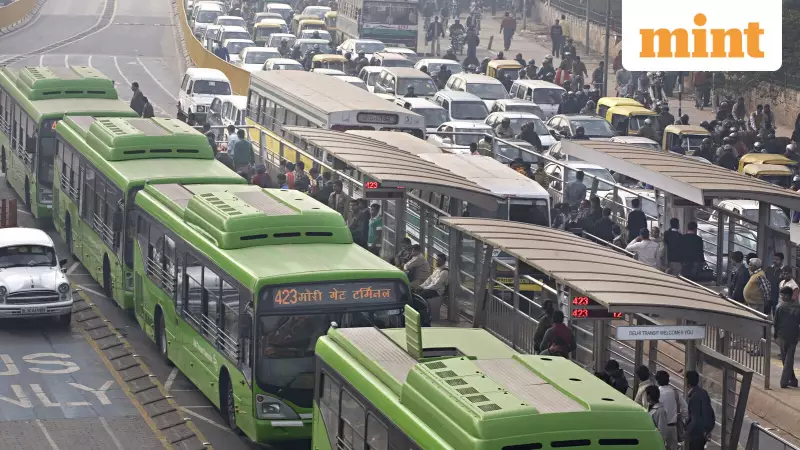
Delhi, which continues to battle severe air pollution, is set to receive the lion's share of this procurement. The capital city has been allocated a substantial 3,330 electric buses through this tender. Following Delhi, Mumbai will get 1,500 buses, Pune 1,000, while Hyderabad and Ahmedabad will receive 200 buses each.

The demand spans multiple bus configurations to suit different urban routes, including 7-metre, 9-metre, and 12-metre models, in both air-conditioned and non-AC variants. With electric buses typically priced between ₹85 lakh and ₹1.8 crore, assuming an average cost of ₹1 crore per unit, the total business opportunity easily exceeds ₹6,000 crore for the winning manufacturers.
Legacy Players Seek Redemption After Previous Setback
This latest tender is viewed as a crucial opportunity for established automotive giants who faced disappointment in the recent past. It comes just weeks after the conclusion of the country's largest-ever tender for 10,900 e-buses under the central government's PM E-Drive scheme.
In that landmark tender, newer manufacturers like PMI Electro Mobility and Eka Mobility secured more than two-thirds of the total buses. PMI Electro Mobility won contracts for 5,210 e-buses, while Eka Mobility bagged 3,485. Among the legacy players, only Olectra Greentech managed a partial win with 1,785 buses.
Notably, industry stalwarts such as Tata Motors and VE Commercial Vehicles Ltd (Volvo-Eicher) did not win a single e-bus in that round. Ashok Leyland was unable to participate due to what it described as a technical glitch, a matter it has challenged in the Delhi High Court.
A spokesperson for Eka Mobility has confirmed the company's participation in the new tender. Other manufacturers, including Tata Motors and CESL, had not responded to queries at the time of reporting.
Operational Model and Industry Capacity Expansion
The government is continuing with the Gross Cost Contracting (GCC) model for this procurement. Under this framework, payment is made on a per-kilometre basis over a long-term contract period, usually spanning 10-12 years. This model involves fleet operators who procure the buses from manufacturers and run them for city or state transport authorities.
This structure allows automakers to focus solely on manufacturing without holding the buses on their balance sheets, while operators handle the operational complexities without investing in bus production. In the previous 10,900-bus tender, manufacturers participated through operators like Chartered Speed and GreenCell Mobility.
Sanyam Gandhi, a whole-time director at Chartered Speed Ltd, highlighted the scale of the opportunity, noting the large existing fleet of around 150,000 buses run by government authorities. He stated that the collaboration model between e-bus makers and operators is designed to meet the massive demand expected in the coming years.

The industry is already scaling up in anticipation. Registration of electric buses in India jumped from 1,988 in 2022 to 4,408 in 2025. Eka Mobility is increasing its annual capacity to 6,000 buses by the end of this financial year. PMI Electro Mobility is constructing a new plant in Neemrana, Rajasthan, with a planned annual capacity of 15,000 units. Furthermore, Ashok Leyland recently inaugurated a new greenfield electric vehicle manufacturing facility near Lucknow, Uttar Pradesh.
The final decision to bid in this 6,230-bus tender rests with individual companies, based on their current capacities and order books. However, the intense competition underscores India's accelerating transition to electric public mobility, driven by both environmental imperatives and substantial government procurement.