

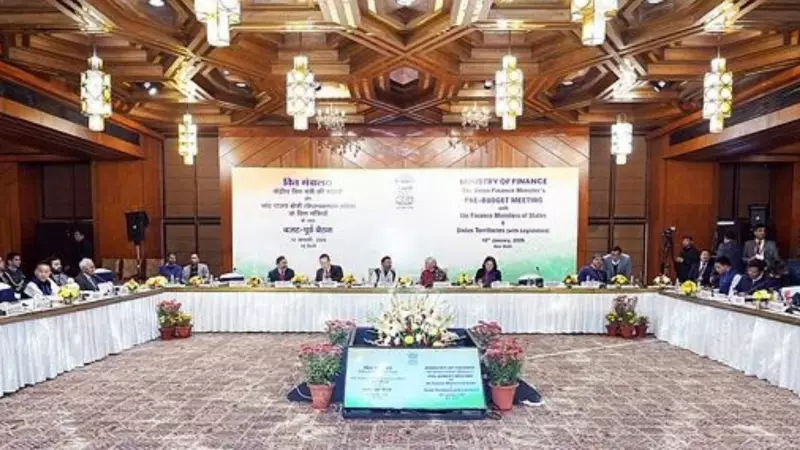
State governments have raised significant concerns over shrinking fiscal space and revenue losses stemming from recent Goods and Services Tax (GST) rate cuts during a crucial pre-Budget consultation with Union Finance Minister Nirmala Sitharaman. The meeting, held in New Delhi on Saturday, saw participation from top officials of nearly all states and union territories, who also flagged the erosion of their fiscal autonomy.
Key Concerns: GST Cuts and Shrinking Revenue
The revenue loss due to mid-year GST rationalisation, which came into effect in September last year, was a dominant theme. Finance ministers from several states, including West Bengal, Telangana, Punjab, Kerala, and Karnataka, pointed out that while the rate cuts were pro-people, they have severely impacted state coffers. Karnataka's Revenue Minister, Krishna Byre Gowda, provided a stark example, stating that post-rationalisation, his state's GST growth plummeted from 12% to 5%, creating an annual shortfall of approximately Rs 9,000 crore.
States argued that while the central government compensates for its own revenue loss through levies like the cess on pan masala and excise duty on tobacco, states lack similar flexibility. A key demand emerged for a 50:50 sharing of these cess and excise collections to restore fiscal balance and uphold cooperative federalism.

Demands for Long-Term Loans and Funding Equity
Beyond GST, states put forward a list of requests to bolster their capital expenditure and developmental projects. There was a strong push for the continuation and enhancement of the Scheme for Special Assistance to States for Capital Investment (SASCI). States want higher allocations under this scheme, which provides 50-year interest-free loans. Since 2020-21, over Rs 4.25 lakh crore has been disbursed under SASCI, aiding in asset creation.
Another critical issue was the funding pattern for centrally sponsored schemes (CSS). Goa's Chief Minister Pramod Sawant emphasised the need for a more equitable Centre-state funding formula, considering unique challenges like coastal ecology and tourism responsibilities. States also expressed apprehension about the newly introduced Viksit Bharat—Guarantee for Rozgar and Ajeevika Mission (Gramin), which replaces MGNREGA. The new scheme mandates states to bear 40% of the cost, a significant shift from the earlier model where the Centre funded 100% of labour costs.
State-Specific Appeals and Broader Federal Issues
Individual states presented their specific fiscal challenges. Kerala's Finance Minister KN Balagopal requested a special fiscal correction package of over Rs 21,000 crore to address a resource gap caused by borrowing constraints and methodology changes in GSDP estimation. He cited the "immature implementation of GST" and the cessation of compensation as major concerns.
West Bengal's Finance Minister Chandrima Bhattacharya questioned why states are being treated as "step-children" and called for the inclusion of cess and surcharge in the divisible pool of taxes. She also sought the release of pending funds worth Rs 1.97 lakh crore for various state schemes. Furthermore, she proposed a constitutional amendment to explicitly include 'climate' as a subject in either the state or central list.
The meeting also saw demands for better remuneration for frontline workers like Anganwadi and ASHA workers, with multiple states calling for a revision in their pay. The Union Finance Ministry noted the suggestions, setting the stage for negotiations as the central government prepares the final Budget for the upcoming fiscal year.






