

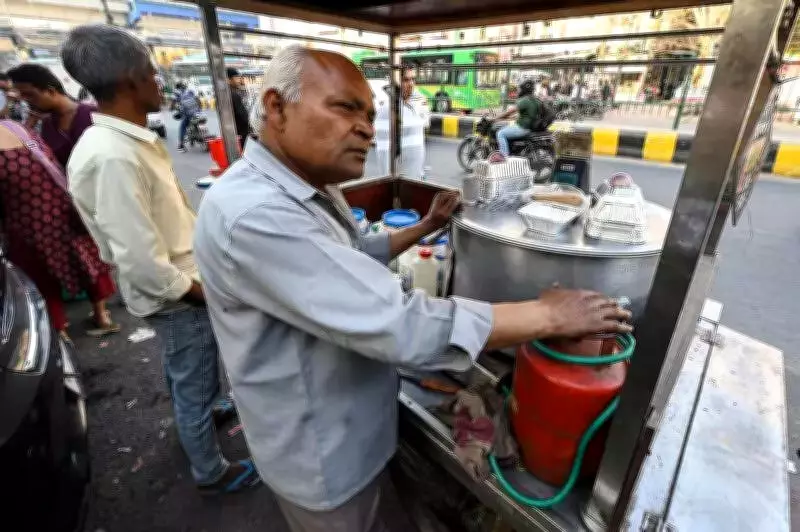
West Asia Conflict Disrupts LPG Supply, Puts Delhi's Street Food Vendors at Risk
The bustling street food economy of Delhi, sustained by countless tea stalls, momo vendors, dhabas, tandoor shops, and roadside Chinese joints, is beginning to feel the intense pressure from the ongoing war in West Asia. Geopolitical tensions are tightening supplies of commercial LPG cylinders, as shipping routes face disruptions and the government prioritizes domestic cooking gas. This situation threatens the daily livelihoods of thousands of small vendors who depend heavily on LPG for cooking, with many fearing that even brief supply interruptions could force their businesses to shut down.
Vulnerability of Informal Sector and Reliance on Domestic Cylinders
Unlike larger, organized restaurants, most roadside eateries operate with limited LPG stock and rely on frequent refills, making them particularly susceptible to delays. At a tea stall in Lajpat Nagar, R K Pathak, originally from Gonda in Uttar Pradesh, stands beside a small stove balanced on a 15-kg domestic LPG cylinder—an illegal but common practice in the informal sector where commercial cylinders are deemed too expensive.
"Business slows down from the beginning of summer as more people opt for cold drinks instead of tea," Pathak explained. "On top of that, if gas becomes dearer, we will be directly hit. We cannot hike the price of tea. Who will buy it then?" He has only one cylinder left, estimated to last three to four days, and worries about rising prices. "If prices keep rising, how will we manage? As it is, we have to pay government officials to keep our stalls running," he added.

Rising Black Market Prices and Operational Challenges
Across the city, vendors report that informal use of domestic cylinders and purchases through unofficial channels are routine in the unorganized food sector. However, many note that black market prices are already climbing due to the West Asia conflict. Payal Kashyap, who runs a small street café, highlighted the steady increase in LPG costs over the years.
"Around 13 years ago, we used to get a cylinder for about Rs 315. Now, it is around Rs 1,500. Why do prices keep on increasing? Why don't they ever come down," she wondered. Her kitchen consumes about four cylinders monthly, depending on sales. "Cooking without gas isn't possible. Induction doesn't give the same taste. If restrictions tighten further, we'll have no option but to buy cylinders from the black market," she stated.
In Laxmi Nagar, biryani vendor Mukesh Mishra showed a small 5 kg commercial cylinder beside his cart. "This lasts only two days, and we mostly use it for reheating," he said. "The biryani is cooked at home using a domestic cylinder. There's no cylinder left at home now and we need to refill every alternate day." Momo seller Manoj Yadav, who uses nearly 6 to 7 kg of gas daily, expressed concern over supply uncertainty. "Today we managed with the gas we had. Tomorrow, we'll see if we get more," he said. "If we can't, we'll have to buy it from the black market. Otherwise, the stall will shut down."
Government Regulations and Industry Response
While commercial cylinders typically have no refill limit, domestic connections—which many small vendors illegally rely on—come with caps on subsidized refills allowed per month, complicating business sustainability if commercial supplies tighten. To prevent hoarding, the government has increased the refill time from 21 to 25 days for domestic connections.
Although the informal sector feels immediate pressure, restaurant associations indicate that Delhi's organized restaurant sector has not yet experienced the level of disruption seen in cities like Pune and Bengaluru, where some establishments have faced temporary shutdowns due to LPG shortages. Sagar Daryani, president of the National Restaurant Association of India (NRAI), noted that Delhi is somewhat better positioned due to partial reliance on piped natural gas (PNG).

"Many malls and some high-end restaurants in areas like Connaught Place operate on PNG connections," he said. "But that still accounts for only about 10-15% of the sector. Nearly 80% of restaurants depend on LPG cylinders." Daryani warned that while most restaurants in Delhi have stock for a day or two, prolonged disruptions could quickly create problems. "There is already a bit of worry as people think commercial connections might be restricted," he added.
Advisories and Broader Economic Impact
The NRAI has issued advisories to restaurants, suggesting they rationalize menus by retaining dishes with lower gas consumption, adopt batch cooking, and reduce gas usage during peak hours. The association has also repeatedly written to the central government, requesting that the restaurant industry be included in the essential services category, as was done during the COVID-19 pandemic.
Across India, the restaurant industry employs approximately 8.5 million people and includes nearly five lakh establishments, according to NRAI data. Any prolonged LPG disruption could therefore significantly impact both businesses and jobs. Amit Bagga, co-founder of Daryaganj Restaurants and co-head of NRAI's Delhi chapter, cautioned that restrictions might encourage cylinder hoarding and disrupt legitimate supply chains, exacerbating the crisis for vendors and restaurants alike.





