

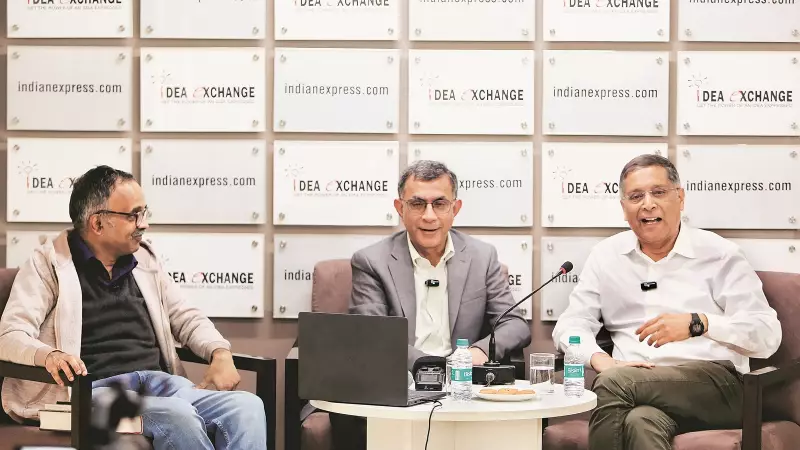
In a comprehensive discussion moderated by Harish Damodaran of The Indian Express, former Chief Economic Advisor Arvind Subramanian and Johns Hopkins University professor Devesh Kapur delved into the paradoxes of India's development story. They analysed why the nation achieved macro stability while grappling with deep-rooted structural instabilities, and why it spectacularly bypassed a manufacturing-led growth phase.
The Puzzle of Skipped Manufacturing and Precocious Servicification
Arvind Subramanian highlighted a critical economic anomaly. While East Asia and China followed a classic path from agriculture to low-skilled manufacturing and then to high-skilled services, India leapfrogged directly to services. He pointed out that in 1978, China and India had similar economic profiles, but China's agricultural boom propelled its transformation into a manufacturing powerhouse.
"The real puzzle," Subramanian stated, "is that after the 1990s liberalisation, when licensing and other constraints were removed, formal manufacturing still did not take off." He provided a stark comparison: China commands a 40-50% share of global exports in apparel and footwear, while India's share is a mere 3-4%. This missed opportunity, he argued, has cost India massively in terms of employment, especially for women.

Subramanian identified three key reasons for this "precocious servicification": lack of agricultural productivity growth to generate demand for mass-market goods; a "panoply of regulations" leading to small-scale, uncompetitive "midgets making widgets"; and the "Dutch disease" of talented youth spending years preparing for government exams instead of joining the manufacturing workforce.
The Double-Edged Sword of Precocious Democracy
Devesh Kapur began by acknowledging India's extraordinary achievement in building a nation amidst immense diversity without the mass violence seen in the US, China, or Vietnam. He credited the early choice of democracy and universal adult franchise as a key instrument of nation-building.
However, both experts detailed the economic costs of this precocious democracy. Subramanian cited the failure to implement serious land reforms due to vested interests within the ruling Congress party, which hampered agricultural productivity. More significantly, he described India's "Kamadhenu fiscal state" – a reference to the mythical wish-fulfilling cow. Despite being among the world's fastest-growing economies post-1990, India maintained the highest fiscal deficit among major peers.
"Precocious democracy means every manner of vested interest has a claim on the government," Subramanian explained. This led to a tax system that excludes rich farmers and property owners, and an expenditure side bloated with subsidies, crowding out vital development and defence spending.
Kapur added that the very competitiveness of Indian democracy has exponentially increased the demand for election money, with the average electoral cycle now reduced to 1.2 years due to frequent national, state, and local polls. This, he argued, fuels corruption and short-term policy thinking focused on visible, instant deliverables like cash transfers.
Governance, Higher Education, and the Path Ahead
The conversation turned to the performance of the current government. Subramanian credited the first term for significant reforms like the GST and the bankruptcy code, and the successful implementation of new welfarism (toilets, bank accounts, cooking gas). The government's strength in implementation is why public infrastructure and welfare schemes took off.
However, he noted a shift post-2017-18 towards protectionist "economic nationalism," aligned with its cultural agenda. The key missing ingredient for private investment, Subramanian emphasised, is the rule of law and a state that is not weaponised to target or favour specific groups.

Kapur expressed deep concern about the state of higher education, warning against packing public universities with ideologically vetted but academically mediocre faculty. "First-rate people hire first-rate people, second-rate people hire third-rate people," he remarked. He lamented that while India created four new colleges a day over 25 years, education is about "software" (quality faculty) and not just "hardware" (buildings).
On the Universal Basic Income (UBI) concept he championed in the 2016-17 Economic Survey, Subramanian observed that while the principle of a basic income is sound, its implementation in India has become additive to existing subsidies rather than a replacement for them. The political appeal of cash transfers, he cautioned, makes them susceptible to competitive populism and escalation.
Looking forward, both experts addressed the demographic challenge. Kapur noted that India's school-going age population has already peaked, offering a chance to shift from quantity to quality in education. Subramanian argued that the Hindi heartland states like Uttar Pradesh and Bihar, with their lower wage rates, should be the natural destinations for low-skill manufacturing, emulating the success of states like Tamil Nadu rather than China.
The session concluded with Subramanian reflecting on the importance of critical voices within government, acknowledging their scarcity not just in India but globally in an era of strongman politics.





