

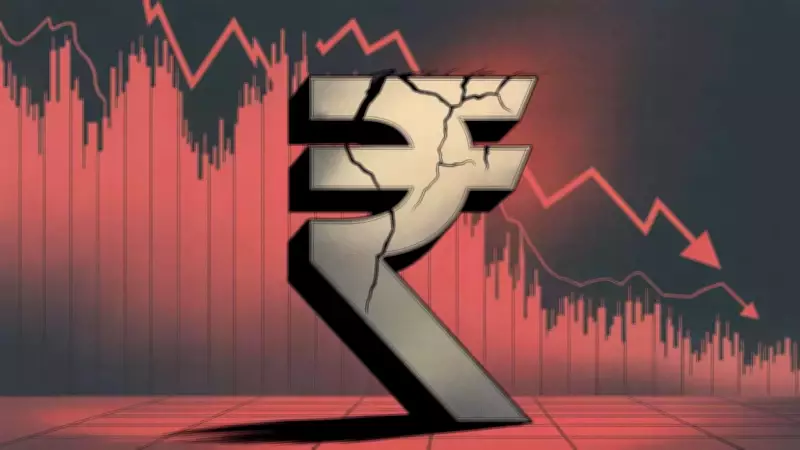
Indian Rupee Plummets to All-Time Low Against US Dollar Amid Geopolitical Turmoil
The Indian rupee experienced a severe decline on Friday, dropping by 82 paise or nearly 1 percent to settle at a provisional all-time low of 93.71 against the US dollar. This sharp depreciation marks a significant milestone in the currency's performance, driven by a combination of persistent foreign fund outflows and a dramatic surge in global crude oil prices. The escalating geopolitical tensions in the Middle East, particularly involving Israel and Iran, have further exacerbated the situation, creating a perfect storm of negative factors for the rupee.
Key Factors Driving the Rupee's Decline
Forex traders have highlighted that the domestic currency remained under intense pressure throughout the trading session. Elevated energy prices and a pronounced shift towards risk aversion among global investors have severely dented market sentiment. The heightened geopolitical uncertainty has fueled widespread concerns that higher oil costs could significantly widen India's trade deficit and push up inflation, adding to the economic challenges.
At the interbank foreign exchange market, the local unit opened at 92.92 against the greenback and quickly breached the 93-mark for the first time in history. It continued to weaken steadily during the session before settling at the provisional low of 93.71, representing a decline of 82 paise from the previous close. This follows a slump of 49 paise on Wednesday, when the rupee ended at its earlier record low of 92.89 against the US dollar. Forex markets remained closed on Thursday due to the Gudhi Padwa holiday.

Expert Analysis and Market Outlook
Anuj Choudhary, Research Analyst at Mirae Asset Sharekhan, provided insights into the situation. "The rupee hit fresh all-time lows on Friday amid geopolitical tensions in West Asia and FII outflows. Rising global crude oil prices, too, have pressured the rupee," he stated. Choudhary noted that major central banks, including the US Federal Reserve, European Central Bank, Bank of England, and Bank of Japan, have left interest rates unchanged in their recent monetary policy meetings. These institutions cited inflation concerns while reiterating their readiness to adjust policy as required.
Choudhary added, "We expect the rupee to trade with a negative bias as escalating geopolitical tensions and rising crude oil prices may continue to pressure the rupee." He projected that the USD-INR spot rate is likely to move in the range of Rs 93.20 to 93.80 in the near term, indicating ongoing volatility and potential further weakness.
Broader Market Movements and Data
Meanwhile, the dollar index, which measures the greenback's strength against a basket of six currencies, was trading 0.35 percent higher at 99.58, reflecting the US dollar's robust performance. Brent crude, the global oil benchmark, rose sharply by 1.84 percent to USD 110.7 per barrel in futures trade, underscoring the impact of geopolitical risks on energy markets.
On the domestic equity market front, benchmark indices showed some resilience by recovering from the previous session's losses. The BSE Sensex was trading 325.72 points, or 0.44 percent, higher at 74,532.96, while the NSE Nifty gained 112.35 points, or 0.49 percent, to 23,114.50. However, this positive movement in equities was overshadowed by the currency's decline.
According to exchange data, foreign institutional investors (FIIs) sold equities worth Rs 7,558.19 crore on a net basis on Thursday, adding significant pressure on the local currency. This substantial outflow highlights the ongoing capital flight from Indian markets amid global uncertainties.
Implications for the Indian Economy
The rupee's record low has several critical implications for the Indian economy:

- Increased Import Costs: A weaker rupee makes imports more expensive, which could lead to higher prices for goods and services, contributing to inflationary pressures.
- Trade Deficit Concerns: With crude oil prices soaring, India's import bill is likely to rise, potentially widening the trade deficit and straining the country's balance of payments.
- Investor Sentiment: Persistent FII outflows and currency volatility may deter foreign investment, impacting capital flows and economic growth prospects.
- Policy Challenges: The Reserve Bank of India may face increased pressure to intervene in the forex market or adjust monetary policy to stabilize the currency and control inflation.
As geopolitical tensions continue to simmer and global oil prices remain elevated, the rupee's trajectory will be closely watched by market participants and policymakers alike. The coming days are likely to see heightened volatility as these external factors play out, with potential further impacts on India's financial markets and broader economic stability.





