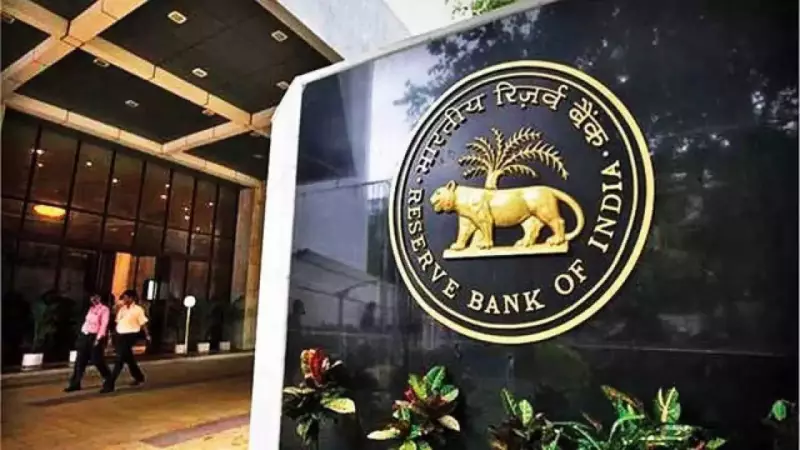
With the Indian economy showing resilience, a top economic advisor has made a strong argument for the Reserve Bank of India (RBI) to keep interest rates unchanged in its upcoming policy review. Ranen Banerjee, Partner and Leader of Economic Advisory Services at PwC India, cautioned that a rate cut at this juncture would be premature and akin to "wasting a bullet."
MPC Meeting Unlikely to See Rate Action
The central bank's Monetary Policy Committee (MPC) is scheduled to convene for three days from February 4 to 6, 2026. This will be the final MPC meeting of the current financial year and will be chaired by RBI Governor Sanjay Malhotra. According to Banerjee's conversation with PTI, the committee is unlikely to announce a reduction in the policy repo rate during this session.
"If the growth numbers are holding up and the base year revision is also on the anvil, which is expected to provide better estimates, then there is no need for a rate cut," Banerjee stated. He emphasized that with economic growth remaining robust and inflation staying within a manageable range, there is no pressing need for monetary easing.

Private Capex Driven by Demand, Not Rates
Banerjee elaborated on a key reason for maintaining the status quo, arguing that private sector capital expenditure (capex) is not primarily stalled by high-interest rates. Instead, he pointed to other fundamental factors.
"I do not think that the private capex is held up because of the interest rate. It is because there is an uncertainty of demand or the confidence in demand or sustainability of demand is not there and the capacity utilisation is still in the range of 70–75 per cent," he explained. The economist highlighted that unless capacity utilization climbs closer to the 85 per cent mark, businesses feel no immediate urgency to invest in creating additional capacity. This makes demand visibility a far more critical driver for investment than borrowing costs.
A Case for a Prolonged Pause
The PwC leader suggested that the MPC should opt for an extended period of holding rates steady rather than initiating further easing. He reiterated his central metaphor, stating, "Firing a bullet when it is not needed as we are having good growth and contained inflation. So, there is no need for a rate action at this point of time."
This advice comes against the backdrop of the RBI's recent monetary policy trajectory. In the previous month, the six-member MPC had voted unanimously to cut the repo rate by 25 basis points to 5.25 per cent, while keeping a neutral stance. That decision marked the fourth rate cut since February 2025, following pauses in the August and October reviews. Over the course of the calendar year 2025, the RBI had cumulatively reduced the key policy rate by 125 basis points from a peak of 6.5 per cent.
The central bank continues to operate under its mandate to maintain the Consumer Price Index (CPI)-based retail inflation at 4 per cent, with a tolerance band of 2 percentage points on either side. The current economic conditions of steady growth and benign inflation provide the space for the RBI to conserve its policy ammunition for future challenges.