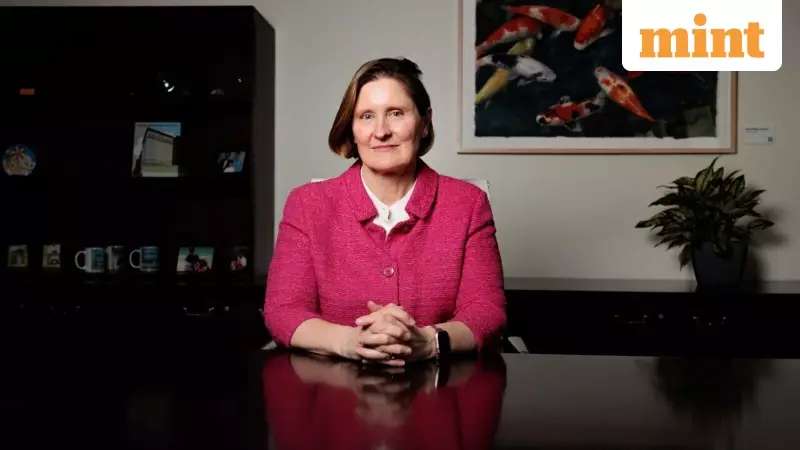
Philly Fed President Stands With Powell, Sees No Rush for Rate Cuts
Philadelphia Federal Reserve President Anna Paulson has voiced her firm support for Fed Chair Jerome Powell. She made these comments during her first national interview since taking office last July. Paulson stated that Powell has been "very effective" in his leadership role.
Powell Faces Investigation, Paulson Defends His Integrity
Jerome Powell disclosed on Sunday that he faces a criminal investigation. This probe relates to renovations at the Fed's Washington headquarters. Powell claims the investigation is actually about monetary policy. He says it reflects President Trump's desire for lower interest rates.
Paulson strongly defended Powell's statement. "His statement was really strong. I think it really speaks for itself," she said. She praised the consistent leadership at the Federal Reserve over many decades. According to Paulson, this strong leadership has benefited the American people.

Paulson has attended rate-setting committee meetings since 2019. She previously served as research director at the Chicago Fed. From her experience, she finds Powell's ability to foster open conversation impressive. "You want to set up conditions where people are able to take actions that are good for the institution and good for the economy," she explained.
Current Rate Policy: Patience Over Hasty Cuts
Paulson currently shares the prevailing view at the Fed. She believes there is no urgent need to cut interest rates again. She will become a voting member on interest rates this year. Paulson supported the Fed's decision to cut its short-term benchmark rate at the last three meetings. The most recent cut in December brought rates to a range between 3.5% and 3.75%.
She expects inflation to decline meaningfully toward the Fed's 2% target by year's end. However, she is comfortable holding rates steady at the upcoming January 27-28 meeting. Paulson thinks current rates are slightly above neutral levels. This means they neither spur nor slow economic growth significantly.
"I want monetary policy restrictiveness to be playing a role to get us all the way back to 2%," Paulson stated. She believes this slightly restrictive stance is appropriate for now. It helps complete the task of bringing inflation down fully.
Future Rate Cuts: Conditions and Timing
Paulson said she could favor modest rate cuts later in 2026. This would depend on specific conditions being met. She would support cuts if inflation data validates her expectation that price pressures are easing. Alternatively, she would consider cuts if evidence shows job market conditions deteriorating unexpectedly.
She plans to pay particular attention to January price data. This data will be released next month. Businesses often reset prices at the beginning of the year. If companies are planning larger price increases, this should become apparent soon.
If her baseline outlook proves correct, Paulson believes the Fed should move to neutral interest rates. She defines neutral as "a little lower than we are now." Her current views place her on the dovish side of the rate-setting committee. She sees higher risks to the job market than risks of stubborn inflation.
Labor Market Observations and Concerns
Paulson identified the labor market cooling as the biggest economic surprise of 2025. However, she noted this cooling process didn't accelerate, which she finds unusual. "The labor market could break quickly," she warned. "So any sign of breaking versus bending is going to be something that I pay sharp attention to."
Last year, approximately 95% of private-sector job growth occurred in just one sector. This sector was healthcare and social assistance. Paulson remarked that a solid, healthy economy should generate jobs across multiple sectors, not just one.
Research suggests that during periods like the current one, the labor market signal often proves most significant. The job market is slowing while economic output, measured by GDP, continues expanding solidly.
Inflation Outlook and Business Behavior
Paulson emphasized the critical importance of returning inflation to the 2% target. She is less concerned about inflation than some colleagues. She sees evidence that last year's goods price increases will reverse this year.

Business executives report being more concerned about preserving market share than in previous years. This makes them reluctant to raise prices and risk losing customers. "It's not like demand conditions are so strong that it's easy to raise prices," Paulson observed. "Firms are being very careful, very thoughtful."
Paulson's comments come as several Fed colleagues have vouched for Powell's integrity and leadership this week. These colleagues were divided at the end of last year over rate-setting decisions. Powell faced growing opposition to the rate cuts he led his colleagues to implement.