

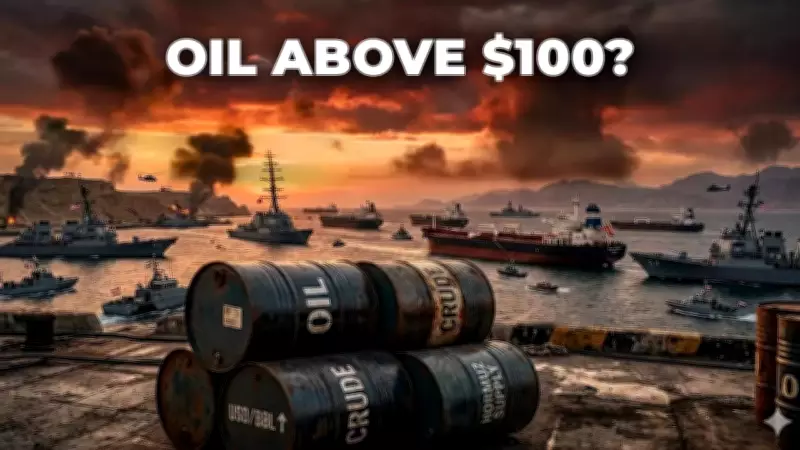
Will Oil Prices Surge to $100 Amid Escalating Middle East Tensions?
Oil, the lifeblood of global economies, faces unprecedented pressure as conflicts in the Middle East intensify. Recent attacks by Israel on Iran, coupled with incidents in Kuwait, Bahrain, Dubai, and Doha, have sparked fears of a severe energy shock reminiscent of the 1970s. The U.S.-Israel war with Iran has heightened concerns over potential supply disruptions, with global markets bracing for impact.
Historical Context: The 1970s Energy Shocks
During the 1970s, two major oil crises sent shockwaves through global markets. The first occurred in 1973-74 when Arab OPEC nations imposed an oil embargo on the United States and its allies for supporting Israel in the Yom Kippur War. This led to sharp supply reductions, skyrocketing prices, fuel shortages, and high inflation in Western nations.
The second crisis unfolded in 1979 following the Iranian Revolution, which severely curtailed Iran's oil production. Once again, constrained output drove crude prices to steep highs, underscoring the vulnerability of global energy supplies to regional instability.

The Strait of Hormuz: A Critical Chokepoint
Today, the focus has shifted to the Strait of Hormuz, a narrow waterway between Oman and Iran that serves as a vital transit corridor for international oil trade. According to data from Kpler, approximately 13 million barrels per day passed through the strait in 2025, accounting for about 31% of total seaborne oil flows. This route is essential for crude exports from Persian Gulf producers like Saudi Arabia, Iran, Iraq, and the United Arab Emirates, as well as for Qatar's liquefied natural gas shipments.
Iran has repeatedly threatened to shut the Strait of Hormuz in retaliation for attacks, and recent VHF radio warnings from Iran's Revolutionary Guards have raised alarms. Although Tehran has not officially confirmed any closure order, vessel movement through the passage has declined sharply, with reports of three ships targeted near the Persian Gulf entrance.
Potential Supply Disruptions and Alternative Routes
If Iran successfully blocks the Strait of Hormuz, the fallout could be profound. Saul Kavonic, head of energy research at MST Marquee, warned that such a scenario might be three times more severe than the 1970s crises, potentially driving oil prices into triple digits and pushing LNG prices to record highs.
Some OPEC producers have limited capacity to bypass the strait. Saudi Arabia can redirect part of its exports through the East-West Pipeline to a Red Sea terminal, with a capacity of up to 5 million barrels per day. The UAE operates the Habshan-Fujairah pipeline, handling around 1.5 million barrels daily. However, Iraq, Kuwait, Qatar, and Bahrain remain heavily dependent on the strait, and a shutdown would still significantly disrupt global supply flows.
Iran's Oil Output and Economic Vulnerabilities
Iran produces over 3 million barrels of crude per day, roughly 3% of global output, making it the fourth-largest producer in OPEC. Despite international sanctions, its production has risen to about 3.3 million barrels per day, with nearly 90% of exports going to China. Kharg Island, its main export terminal, handles over 2 million barrels daily and is vulnerable to attacks, which could cripple Iran's economy.
Worst-Case Scenarios and Market Implications
Analysts outline a range of outcomes, from minor interruptions to a complete closure of the Strait of Hormuz. Vandana Hari, CEO of Vanda Insights, noted that a full-scale military conflict between the U.S. and Iran could lead to major disruptions in Middle East oil flows. Bob McNally of Rapidan Energy Group described the situation as "very serious" due to heavy reliance on Hormuz transit.
Andy Lipow, president of Lipow Oil Associates, highlighted the risk of attacks on Saudi infrastructure combined with a strait closure, assigning a 33% probability to this severe scenario. The duration and breadth of disruptions will dictate the scale of price surges, with prolonged tensions likely pushing oil above $100 and triggering global inflation.
As tensions mount, the world watches closely, aware that the stability of oil markets hangs in the balance amid escalating Middle East conflicts.






