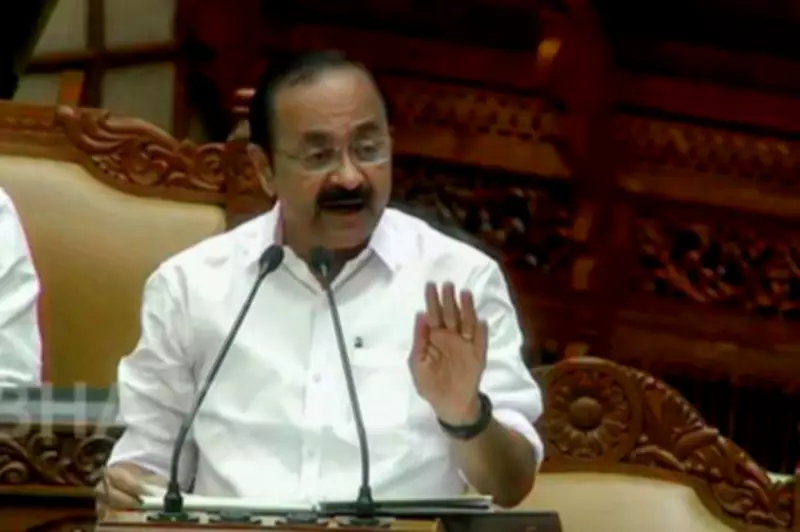
Thiruvananthapuram: The first budget of the V D Satheesan government has outlined the United Democratic Front's (UDF) development vision, which seeks to leverage market-driven opportunities while ensuring robust welfare support for women and vulnerable sections. Presenting the revised budget for 2026-27, Chief Minister and Finance Minister Satheesan described it as a "definitive blueprint" for development and welfare initiatives over the next five years.
Vision for New Kerala
In his budget speech, Satheesan unveiled the government's vision of a new Kerala (Puthiya Keralam), where economic growth and social justice coexist, supported by modern and environmentally sustainable infrastructure. He emphasized a progressive strategy centered on technology-driven reforms in healthcare and education, job creation, improved care for senior citizens, and the social and economic inclusion of marginalized communities.
Accusing the previous Left Democratic Front (LDF) government of distorting budgetary figures, Satheesan stated that he inherited a revenue shortfall of Rs 20,500 crore. He revised the plan outlay for 2026-27 to Rs 30,370 crore from the Rs 35,750 crore proposed in the LDF budget in January. He also reiterated the government's commitment to restructuring the Kerala Infrastructure Investment Fund Board (KIIFB) and announced the formation of an expert committee to recommend comprehensive structural reforms.

Blue Economy as Growth Engine
At the heart of the budget is a strategy to position the blue economy as Kerala's principal growth engine. The government announced Mission Samudra, an ambitious initiative to transform the state into a major global maritime hub within five years. Envisioning Kerala as an integrated "port city," the mission proposes seamless connectivity between road, rail, sea, and inland waterways, linked to manufacturing clusters and greenfield cities to drive a maritime-led economy. Satheesan said a comprehensive maritime policy for developing the state's four key non-major ports—Vizhinjam-Kovalam, Kollam, Beypore, and Azhikkal—would be unveiled soon.
Another major announcement was the proposal to establish a Southern Kerala Economic Corridor and a Rare Earth and Critical Minerals Corridor spanning Thiruvananthapuram, Kollam, and Alappuzha districts. Satheesan noted that the region's deep-water port at Vizhinjam, coastal critical mineral deposits, rare earth reserves, space and technology institutions, and blue economy potential make it ideal for integrated industrial clusters. The proposal also envisages greater private investment in the space sector. Opposition leader Pinarayi Vijayan has alleged that the government is attempting to open rare earth and critical mineral mining to the private sector.
Land Reforms and Social Sector
The budget proposes sweeping reforms in land ownership, land-use regulations, and conversion norms under a proposed Land Reforms 2.0 policy. The government also plans to revise the fair value of land across the state. In the social sector, the budget proposes reviving several healthcare programmes introduced by previous UDF governments and creating a mechanism to channel financial contributions from individuals and organizations towards medical treatment and education for economically weaker sections.
To improve youth employability, the government announced measures to strengthen skilling and job readiness. It also reiterated its plan to attract foreign universities by establishing a Kerala Knowledge Valley, an education metropolis, and promised fast-track amendments to the Private Universities Bill to facilitate the project.
Other Key Proposals
Among other proposals are a tribal university and an indigenous zone in Wayanad, aimed at integrating education with livelihoods, technology, and social development while preserving tribal culture and traditional knowledge systems. The budget also proposes setting up a Kerala Health and Life Sciences City, envisioned as an integrated healthcare ecosystem that the government hopes will become Asia's largest medical destination. An international film city in Kochi also figures among the marquee projects.

The revised budget, covering the remaining nine months of the financial year, does not propose significant new revenue mobilisation measures, apart from lowering the tax on low-alcohol beverages compared with hard liquor. Asked about the absence of fresh revenue proposals, Satheesan said the development projects themselves would stimulate economic growth and generate additional revenue.
Welfare Measures
Key welfare measures include an allocation of Rs 600 crore for free travel for women and transgender persons on KSRTC buses, the Oommen Chandy Health Insurance Scheme offering health coverage of up to Rs 25 lakh per family, the She Scooter scheme for women engaged in fish vending, increased kerosene subsidy for fishers, revival of housing projects for SC/ST communities and fishers, reduced taxes on electric vehicles, and a significant cut in the tourist permit tax for luxury buses.