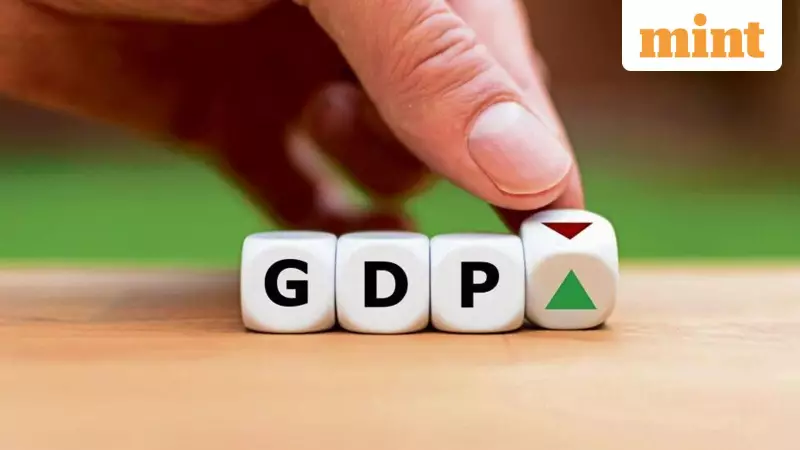
India's economy is poised for a phase of stable expansion in the financial year 2026-27 (FY27), with growth projected to hold steady at around 6.6%, according to a new report from analytics firm Dun & Bradstreet (D&B). This momentum is expected to be underpinned by resilient domestic consumption, sustained public investment, and a long-awaited revival in private capital expenditure, even amid global uncertainties.
Pillars of Growth: Consumption, Public Capex, and Private Investment
In its India Economic Outlook 2026 report, D&B highlights that the Indian economy remains robust, capable of absorbing external shocks due to its macroeconomic stability and strong domestic demand. Arun Singh, Global Chief Economist at Dun & Bradstreet, stated that FY27 will be a "year of stability," with growth largely supported by consumption.
Household spending has been bolstered by policy measures like GST rationalisation and income tax relief from previous budgets, improving disposable income. Festive demand and a gradual recovery in rural markets are further fueling consumption trends.

On the investment front, public capital expenditure is set to remain a key anchor. D&B estimates effective government capital spending could approach 4% of GDP in FY27, as infrastructure, technology, and healthcare remain priority areas. This public spending is creating clear demand signals for the private sector.
Most notably, private investment, a missing link in recent years, is showing strong signs of a comeback. Singh pointed to Reserve Bank of India (RBI) data indicating an expected 21% jump in private capex intentions. Importantly, this spending is increasingly directed towards productivity-enhancing areas like technology, artificial intelligence (AI), and automation, rather than just routine capacity expansion.
Supportive Macro Backdrop and Sectoral Shifts
The report outlines a supportive macroeconomic environment. Inflation is forecast to average around 3.1% in 2026, allowing for calibrated monetary policy easing. External risks are seen as manageable, with the current account deficit projected at about 1% of GDP, cushioned by strong services exports and remittance inflows.
A significant shift is underway in the manufacturing sector. India is moving from a volume-driven model to one focused on value creation. This is evident in growing capabilities in technology adoption, design, supply-chain integration, and strategic areas like semiconductors, electronics, and defence manufacturing. The Production-Linked Incentive (PLI) scheme and rising exports are key drivers here.
Micro, small, and medium enterprises (MSMEs) are expected to be critical growth multipliers, aided by GST simplification, credit guarantees, and adoption of Industry 4.0 technologies.
Emerging Engines: AI, Tourism, and the Blue Economy
D&B identifies several emerging sectors that will redefine the economy. Artificial Intelligence (AI) is transitioning from pilot projects to platform-scale adoption across manufacturing, finance, healthcare, and governance, supported by investments in compute infrastructure and data governance.
The tourism sector is undergoing a structural upgrade, driven by better connectivity, destination development, and digital tools like augmented reality. Niche segments such as spiritual, wellness, medical, and eco-tourism are poised for faster growth.
Furthermore, the blue economy—encompassing maritime trade, fisheries, coastal tourism, and offshore renewables—is gaining traction, with initiatives aimed at improving efficiency and reducing emissions.
Reform Priorities and Fiscal Strategy
Despite the optimistic outlook, the report flags the need for stronger coordination between the central and state governments, especially as cities and districts become primary growth drivers. Timely policy execution and a potential "second round" of reforms are crucial to sustain momentum.

Looking ahead to the Union Budget for FY27, Singh expects a growth-oriented approach coupled with fiscal discipline. The broader policy narrative is shifting from incremental austerity to strategic investment, aiming to balance growth with debt sustainability.
In summary, Dun & Bradstreet envisions India's next growth phase as systems-led, powered by digitised logistics, clean energy, and the scaling up of sectors like AI, advanced manufacturing, and green hydrogen.