

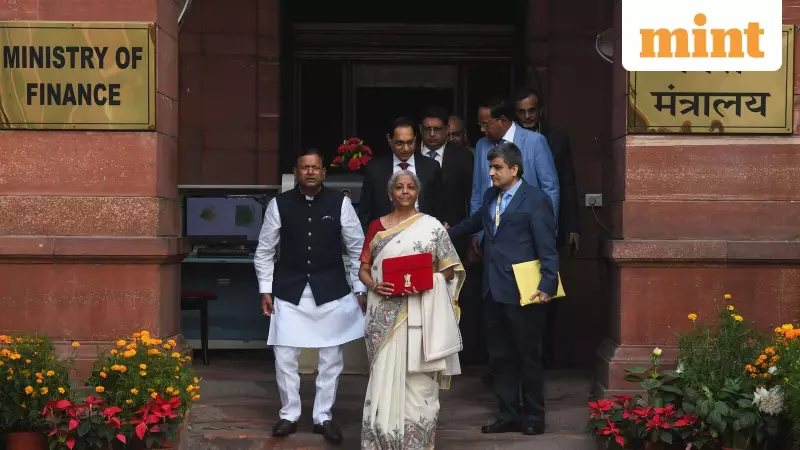
Finance Minister Nirmala Sitharaman to Present Union Budget 2026 on February 1
Finance Minister Nirmala Sitharaman will present the Union Budget for 2026 on February 1 at 11 am. Investors across the country eagerly await the announcement. They want to understand the budget's main focus areas and specific inclusions.
The global economic environment faces significant shifts right now. Trade disputes, changing tariff policies, supply chain disruptions, and rising geopolitical tensions challenge long-standing assumptions about globalization. Experts say this period creates both challenges and opportunities for economies like India.
India continues to integrate into global value chains while pushing for strong domestic growth. The upcoming budget must address these dual priorities effectively.

Expert Calls for Clear and Decisive Budget
Mohit Gulati, CIO and managing partner of ITI Growth Opportunities Fund, shared his views on the budget. He believes global trade lines are hardening. Background friction between leaders like Trump and Modi adds complexity.
Gulati stated that Budget 2026 cannot afford ambiguity. It must be a decisive Atmanirbhar budget focused on strength, scale, and execution. He emphasized this is not a populist budget. India currently has momentum. The key task now is to compound that momentum through clear policy.
Five Key Areas to Watch in Budget 2026
Fiscal Deficit Target
The fiscal deficit shows the government's net borrowing needs each year. It serves as a crucial indicator of fiscal health. A lower figure signals improved financial management.
For FY25, the fiscal deficit result was 4.8%. The government planned a reduction for FY26, setting a target of 4.4%. This aims to decrease debt and promote sustainable growth.
A recent report by Motilal Oswal Financial Services anticipates the FY27 Union Budget will mark a turning point. It expects the gross fiscal deficit to be set at 4.3% of GDP. That is lower than the 4.4% target for FY26.
GDP Growth Projection
Financial market investors will closely watch the GDP growth target for FY27. For the Union Budget related to FY2026, India's real GDP growth prediction was set at 7.4% for FY 2025–26. This was up from 6.5% in FY 2024–25.
Motilal Oswal Financial Services suggests the FY27 budget will likely base its plans on a nominal GDP growth projection of about 10.1%. This provides some leeway to maintain fiscal discipline while still fostering economic growth.
Capital Expenditure (Capex) Focus
The government's capital expenditure in the Union Budget emphasizes creating long-term assets. This includes infrastructure like roads, railways, and energy sources to stimulate economic growth.
Recent budgets have shown considerable increases in capex allocation. For FY2025-26, a notable allocation of ₹11.21 lakh crore (3.1% of GDP) was made.
Motilal Oswal's report projects total expenditure will rise by 7.0% year-on-year in FY27. It could reach ₹52.9 trillion, or 13.4% of GDP.
Mohit Gulati highlighted that it is time to unlock private capex. He explained public capex has carried growth so far. The next phase depends on crowding in private capital. This requires policy certainty, faster clearances, and effective risk-sharing mechanisms.
Atmanirbhar Bharat and Strategic Sectors
According to Mohit Gulati, Atmanirbhar Bharat must mean achieving real scale. He emphasized the government should focus on key sectors like defence, semiconductors, electronics, and energy. The goal should be building real domestic capacity, not just pilot projects or policy headlines.
Analysts propose that emphasizing 'Atmanirbharta' in defence, along with integrating modern technologies like artificial intelligence, goes beyond enhancing current systems. They argue increasing the defence budget should be seen as a strategic necessity, not just a monetary choice.
Personal Income Tax Slabs
All taxpayers, individuals and corporations alike, are eager to learn about potential tax changes. However, many experts believe no major changes will occur in the tax system this year.
In the 2025 Budget, the Finance Minister granted significant tax relief to individual taxpayers under the streamlined tax framework. This acknowledged the middle class's crucial role in national development.

For individuals earning up to ₹12 lakh in total income, there is now no tax liability. This threshold was previously set at ₹7 lakhs. Additionally, income brackets were adjusted. The maximum tax rate of 30% now applies to income exceeding ₹24 lakhs, up from the former cap of ₹15 lakhs.
Experts believe the streamlining of GST has helped reinstate consumer trust, as seen in demand data. Mohit Gulati urged the government to maintain this momentum and avoid policy flip-flops. He encouraged making the top of India open purse strings now to sustain growth.
Disclaimer: The views and recommendations mentioned are those of individual analysts or broking companies. They do not represent Mint. Investors should consult certified experts before making any investment decisions.





