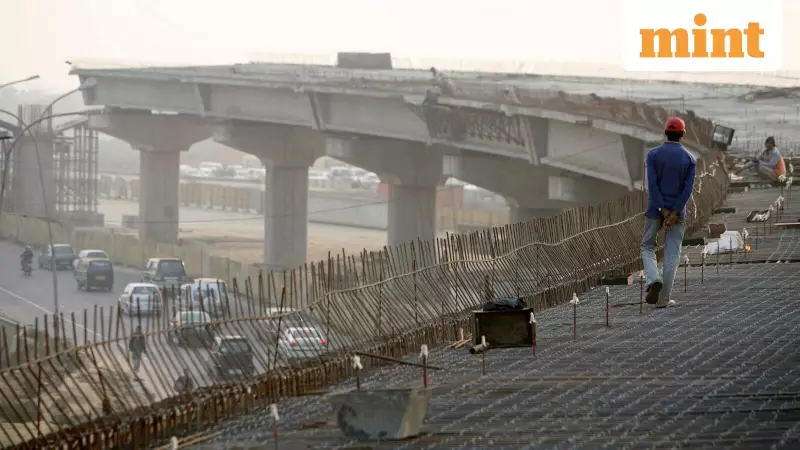
Road Ministry Budget to Hold Steady in 2026-27 Amid Private Capital Push
The Union Budget for 2026-27 is likely to keep the road ministry's allocation nearly flat at around ₹2.72 trillion, matching the revised estimates for 2025-26. This decision reflects a strategic shift toward attracting more private investment into highway construction, even as the pace of building new roads shows signs of slowing down.
Focus on Asset Monetization to Raise Funds
Government officials familiar with the discussions reveal plans to mobilize an additional ₹80,000 crore for new construction projects. This funding will come from monetizing the National Highways Authority of India's operational assets. The methods include toll-operate-transfer arrangements, infrastructure investment trusts, and securitization of upcoming assets.
The Centre provided capital expenditure of ₹2.72 trillion to the Ministry of Road Transport and Highways in 2024-25. It maintained this level in 2025-26, and now expects only a moderate increase or no change at all for the coming fiscal year.

NHAI's Reduced Reliance on Budgetary Support
NHAI's dependence on direct budget allocations is expected to ease in 2026-27. The highway builder plans to float another infrastructure investment trust called Raajmarg Infra Investment Trust to service its debt. This trust has already received approval from SEBI, with its first public issuance anticipated in February.
NHAI's first InvIT, the National Highways Infra Trust, raised ₹46,000 crore across four fundraising rounds starting in 2020. As the authority uses InvIT proceeds exclusively for debt repayment, its outstanding debt has dropped significantly from a peak of ₹3.5 trillion in 2021-22 to ₹2.39 trillion by September 2025.
Reviving Private Investment in Highways
The government's strategy coincides with efforts to bring private capital back into the highway sector. Officials aim to award more projects under the build-operate-transfer model, which saw limited use since 2014. These measures would reduce dependence on large budgetary funds that have supported the sector for several years.
One official noted that current levels of budgetary support should continue for a couple more years before potentially decreasing. The road ministry and Indian Railways together account for more than half of the government's planned capital expenditure each fiscal year.
Challenges with Private Participation Models
Despite the push for private investment, experts highlight difficulties with the build-operate-transfer model. Kuljit Singh of EY India explains that BOT projects face implementation challenges due to limited toll increases linked to low wholesale price inflation and increased traffic risks from new expressways.
"BOT projects do not receive the mandatory 40% capital expenditure grant available under other models," Singh points out. "This requires developers to commit two to three times more equity compared to similar hybrid annuity model projects."
The share of BOT projects in highway contract awards has plummeted from 90% a decade ago to less than 10% currently. Between 2016 and 2025, the road ministry awarded approximately 110,000 kilometers of projects, with the overwhelming majority executed under engineering, procurement, and construction or hybrid annuity models.
Construction Momentum and Future Outlook
Highway construction declined by 12% to 3,468 kilometers in the first seven months of 2025-26, down from 3,920 kilometers during the same period the previous year. The continued slowdown in project awarding over the past two years, combined with extended monsoon conditions, is expected to impact road execution in the current fiscal year.
Suprio Banerjee of Icra Ltd notes that if subdued awarding activity persists, it could pose downside risks to execution estimates. However, the capital outlay for the road ministry has grown significantly from ₹0.66 trillion in FY16 to ₹2.72 trillion in FY26, representing healthy growth despite recent moderation.

Icra expects road awards to reach 8,500-9,000 kilometers in 2025-26, slightly higher than the previous year's estimates. Awarding activity is anticipated to pick up in the second half of FY26 as the ministry addresses land acquisition issues and environmental clearances before project awarding.
The government's final decision on budget allocations will consider revenue projections, economic growth forecasts, and potential savings in revenue spending. The finance ministry recently announced National Infrastructure Pipeline 2.0, comprising 852 infrastructure projects to be developed under public-private partnership mode with combined investment exceeding ₹17 trillion over three years.