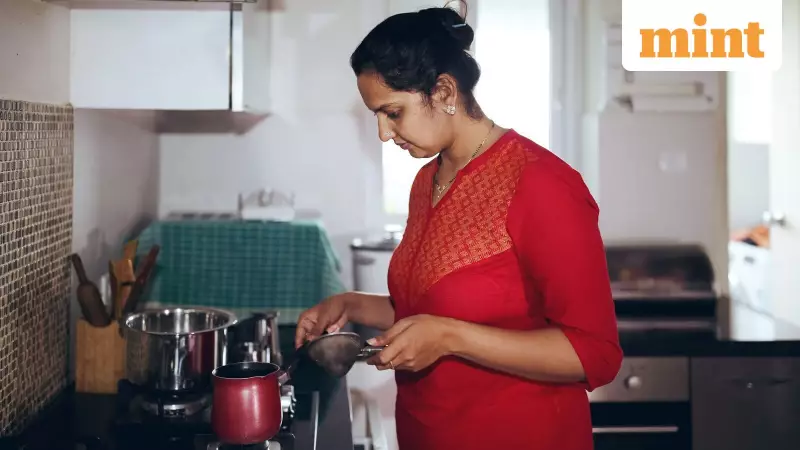
The Unpaid-to-Paid Shift: How Women Get Pushed Out
Devina Mehra raises a critical question about work and gender. She points out a troubling pattern in our society. Work considered "women's work" within households often becomes male-dominated once it starts paying well. This shift happens across various fields, from domestic tasks to high-tech professions.
From Kitchens to Coding: The Exclusion Pattern
Consider traditional feminine skills like makeup, sewing, and cooking. Most people would agree women show natural affinity in these areas. Yet, when these skills translate into paid professions, women face systematic barriers.
Until recently, the Indian film industry's makeup artists' association actually banned women from working as makeup artists. They could only serve as hairdressers. Similarly, a hotel management graduate revealed how hotel kitchens deliberately create hostile environments to discourage women. Abusive language becomes a common tool to drive them away.

In garment export hubs, sewing remains a feminine hobby but women rarely become master tailors in manufacturing units. The pattern repeats everywhere. Unpaid, unvalued work stays in women's domain. The moment the market attaches monetary value, women get edged out.
The Historical Tech Example
This phenomenon extends to technology fields too. People often question women's aptitude for mathematics and technology today. But history tells a different story.
Ada Lovelace, recognized as the first computer programmer, was a woman. During the 1940s, nearly all software programmers were women. The ENIAC computer's first programmers were six female mathematicians: Marlyn Meltzer, Betty Holberton, Kathleen Antonelli, Ruth Teitelbaum, Jean Bartik, and Frances Spence.
At that time, hardware design was considered "men's work" while software programming was "women's work." Women dominated programming through the 1960s. Then software gained importance and better pay. Men flooded the field, and suddenly women were characterized as incapable of mastering technology.
Everyday Labor Realities
The pattern appears in agriculture and construction too. Women provide most farm labor in India, yet they rarely own the land they work on. They don't handle monetary transactions for crop sales. Our mental image of an Indian farmer typically features a man, not a woman.
Similarly, women form a large share of construction laborers, but masons and contractors remain almost exclusively male. Women do the hard work while men handle market-facing roles.
The Management Paradox
At home, women receive praise for multi-tasking, emotional management, and maturity. School-age girls take on household chores and sibling care. Married women regulate husbands' emotional states. Yet when management becomes a paid position, men are seen as better managers.
Meanwhile, men often struggle with family responsibilities. They might cut potatoes as instructed but leave the knife and board uncleaned, awaiting specific directions. This behavior resembles low-level employees needing detailed instructions, showing an inability to think independently.
But this treatment applies only to unpaid labor. In paid jobs, men are expected to think of everything and execute better than women.
Economic Implications
Why discuss this in a finance column? Because women constitute half the world's population and should represent 50% of the economy. Even for those uninterested in social equity, the economic reality remains clear.
No country has moved up the income ladder without substantial female participation in the paid workforce. From a purely economic perspective, this pattern of exclusion cannot be ignored. It directly impacts growth potential and national prosperity.
The author, Devina Mehra, founded First Global and wrote 'Money, Myths and Mantras: The Ultimate Investment Guide.' Her insights challenge us to recognize and address this systemic issue for both social justice and economic advancement.