IT Giants Activate Business Continuity Plans as Middle East Crisis Escalates
In response to the escalating crisis in West Asia, including recent Iranian strikes targeting the United Arab Emirates, numerous IT companies and Global Capability Centers (GCCs) have swiftly activated comprehensive Business Continuity Plans (BCPs). These measures include immediate work-from-home arrangements, stringent travel advisories, and temporary office closures to ensure employee safety and operational resilience during this period of heightened geopolitical uncertainty.
Major Tech Firms Implement Remote Work and Travel Restrictions
Tata Consultancy Services (TCS), which employs over 9,000 professionals across the Middle East and Africa region, has mandated remote work for its staff. The company has activated a structured call tree system—a chain-based communication method designed for rapid alert dissemination—to prioritize contacting associates in impacted and neighboring areas. "We are coordinating closely with local authorities and Indian embassies to monitor developments and will provide timely updates as the situation evolves," a TCS spokesperson stated.
Infosys has updated its internal advisory with tighter travel restrictions, permitting only critical travel that requires approval from segment heads and subsequent review by the chief delivery officer's office. Group meetings, events, and conferences in the region are currently restricted.

Wipro, with over 5,500 Middle East employees, has instructed its several hundred UAE-based staff to work remotely. Similarly, JPMorgan has asked employees across its Middle Eastern offices—including Abu Dhabi, Beirut, Cairo, Doha, Dubai, Manama, and Riyadh—to work from home while continuously assessing the situation. "Our businesses continue to operate as usual, and client servicing remains uninterrupted," a JPMorgan representative confirmed.
Financial Institutions and Tech Giants Follow Suit
Goldman Sachs has implemented precautionary measures, including remote work directives across the region, while Standard Chartered maintains normal services under work-from-home arrangements. "Our focus is the safety and wellbeing of our colleagues. The UAE and other Middle East markets remain important parts of our global network," the bank emphasized.
The crisis has prompted organizations in the process of establishing or expanding GCCs in the region to pause non-essential travel and executive visits. Vikram Ahuja, cofounder of ANSR, noted, "If the situation persists, we could see accelerated GCC ramp-ups in India. Global firms will likely deepen their India presence as a stable, high-capability anchor—a trend already underway."
India Emerges as Strategic Operational Hub
Amid rising geopolitical tensions, many technology firms and GCCs are increasingly relying on India as a stable hub for global operations. Companies are running mirror command centers from India and activating BCPs to ensure operational continuity during disruptions. This shift underscores India's growing role as a resilient base for international business operations.
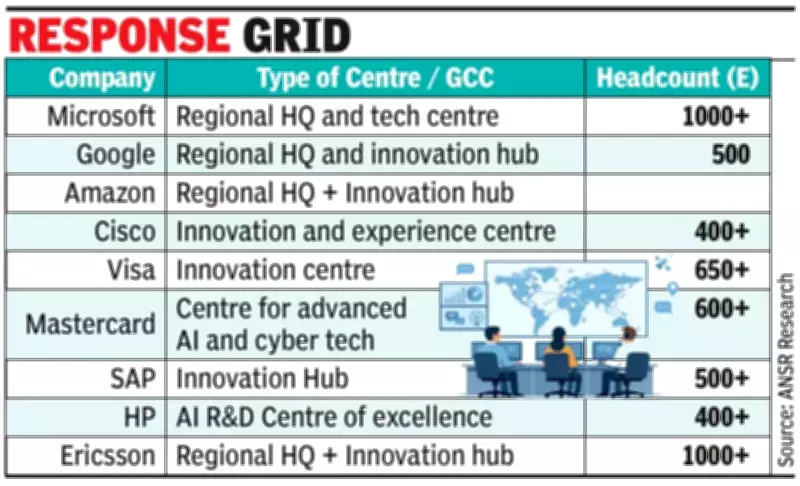
The following table highlights major companies with regional headquarters and innovation centers in the Middle East, illustrating the scale of operations potentially affected:

- Microsoft: Regional HQ and tech centre in Dubai (1,000+ employees)
- Google: Regional HQ and innovation hub in Dubai (500 employees)
- Amazon: Regional HQ and Innovation Hub in Dubai and Abu Dhabi
- Cisco: Innovation and Experience Centre in Dubai (400+ employees)
- Visa: Innovation Centre in Dubai (650+ employees)
- Mastercard: Center for Advanced AI and Cyber Technology in Dubai (600+ employees)
- PayPal: Regional HQ and Tech Centre in Dubai (75+ employees)
- PepsiCo: Regional HQ and Shared Service Centre in Dubai and Riyadh
- SAP: Innovation Hub in Riyadh (500+ employees)
- HP: AI R&D Center of Excellence in Dhahran (400+ employees)
- Salesforce: Regional HQ and AI Innovation Center of Excellence in Riyadh (50+ employees)
- Ericsson: Regional HQ and Innovation Hub in Riyadh (1,000+ employees)
- Qualcomm: Global Engineering Centre in Abu Dhabi (50+ employees)
- Honeywell: Innovation Centre in Abu Dhabi
- Huawei: Innovation Centre in Dubai
As the situation develops, companies remain vigilant, balancing employee safety with business continuity, while India's position as a reliable operational base gains further prominence in global corporate strategy.