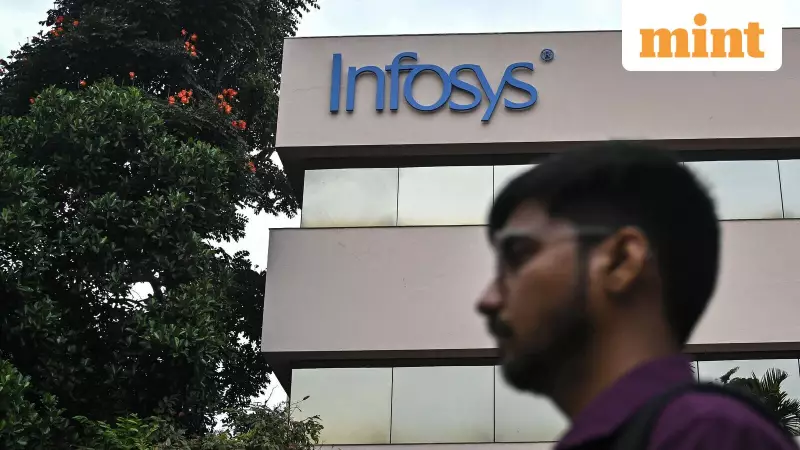
Infosys Rally Masks Deeper AI Threat to Outsourcing Industry
A sudden surge in Infosys shares briefly revived hopes for India's massive outsourcing sector. The company raised its full-year sales forecast, triggering a stock jump of more than 10%. Investors interpreted management's optimistic comments as a signal that large client orders might be returning.
However, this relief rally could prove short-lived. Both Infosys and its larger rival Tata Consultancy Services face immediate profit pressures. TCS recently reported a 14% decline in net income, missing analyst expectations. Infosys registered a 2.2% drop.
Structural Challenges Beyond Temporary Setbacks
Recent turbulence partly stems from India's new labor codes. These regulations forced employers to increase gratuity and other compensation liabilities. But the more significant question concerns the sector's long-term survival in the AI era.

Outsourcing companies traditionally operate through a hybrid model. Engineers deployed to client sites worldwide coordinate with large coding teams based in India. This model now faces multiple threats simultaneously.
The United States, the industry's largest market, implemented a major overhaul of the H-1B work visa program. New entrants now face a steep $100,000 fee, significantly raising operational costs for Indian IT firms.
AI Disruption Accelerates Industry Transformation
Meanwhile, enterprise software orders that once employed millions of coders are drying up. Global trade tensions make clients hesitant about technology investments. More spending now flows toward agentic AI - algorithms capable of making decisions and taking actions independently.
TCS reported its AI services revenue reached $1.8 billion annualized in the September-December quarter. CEO K. Krithivasan declared ambitions to become the world's largest AI-led technology services company.
This ambition raises difficult questions. Does achieving AI leadership require maintaining current employment levels? The industry expanded aggressively during the pandemic when digital transformation projects surged. Just as demand normalized, generative AI emerged as a game-changer.
Productivity Paradox and Workforce Dilemmas
When ChatGPT debuted in late 2022, analysts predicted TCS would reach about $37 billion in revenue for the financial year ending March 2026. With three months remaining, estimates have dropped to $29 billion. Infosys shows a similar pattern.
The AI impact on outsourcing firms appears more immediate than debates about client productivity gains. As some engineers become dramatically more productive using platforms like Claude Code, many programmers risk becoming obsolete.
Managing redundant workforces presents particular challenges. India's top five outsourcing companies have increased labor productivity by less than 2% annually over the past decade. Average value added per employee rose from $34,000 in 2015 to roughly $40,000 currently.
These modest gains primarily benefit labor, though entry-level salaries remain stagnant. Profit per worker has remained practically unchanged in dollar terms.
Political and Economic Headwinds Intensify
Global investors will only re-embrace the outsourcing business when it demonstrably extracts more productivity per employee. In an AI-dominated environment, this likely requires more aggressive investment or larger workforce reductions than companies have delivered so far.
TCS has trimmed its headcount by just over 5% since June 2023. Further reductions prove politically sensitive. Software services have compensated for limited job creation in India's industrial sector. Politicians continue wooing these employers with incentives like free land, hoping they maintain white-collar employment.
Infosys's optimistic forecast temporarily lifted industry spirits. But broader challenges persist. New Delhi's economic relationship with Washington stands at its lowest point in decades. Immigration policies in the crucial US market could become even less favorable.
India's labor code changes represent more than a one-time cost increase - some pressure will endure. Combined with AI's threat to coding jobs through cheap subscriptions, the outsourcing business model continues searching for long-term viability.