

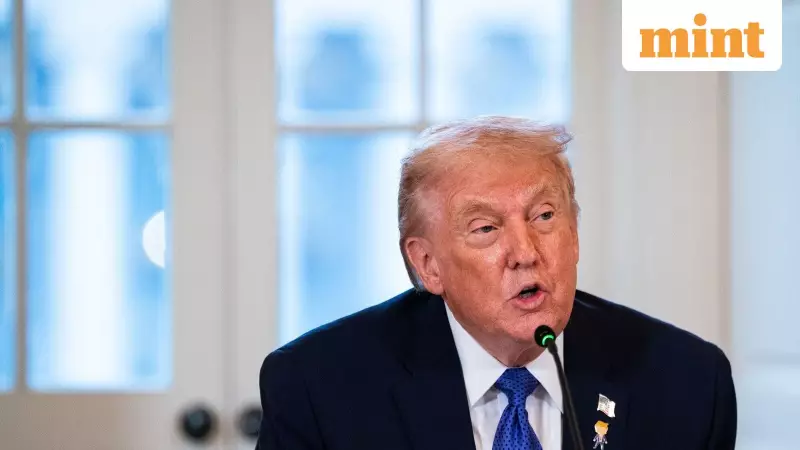
In a move that has sent shockwaves through financial markets, US President Donald Trump has proposed a drastic cap on credit card interest rates, directly targeting consumer affordability concerns. The announcement, made via a post on Truth Social on Friday, January 11, 2026, calls for a one-year cap of 10% on these rates, effective from January 20, 2026.
What the Proposed Cap Means for Consumers and Lenders
The proposed 10% ceiling is dramatically lower than current market rates. According to data from Bankrate, the average credit card interest rate in the United States stands at 19.65%, with store-brand cards charging an even steeper average of 30.14%. If enacted, Trump's cap would represent the lowest rate seen in at least three decades, since 1994.
For consumers, particularly those struggling with debt, the announcement may seem like welcome relief. Data from the Federal Reserve indicates that delinquency rates for subprime borrowers remain high at 16.3%. Furthermore, total credit card balances in the US have ballooned to $1.23 trillion in the third quarter, a $24 billion increase from the previous quarter, as reported by the New York Fed.

However, the mechanism for enacting this cap remains unclear, and its potential side effects are a major concern for economists. A similar proposal was made in a February 2025 bill by Senators Josh Hawley (R-Mo.) and Bernie Sanders (I-Vt.), but it failed to gain political traction at the time.
Immediate Fallout for Major Banks and Credit Card Issuers
The financial industry is bracing for a significant impact. Credit card lenders earned a record $130 billion in interest and fees in 2022, as per a 2024 Consumer Financial Protection Bureau estimate. A rate cap would directly attack this primary revenue stream—net interest income—potentially triggering a negative reaction in bank stocks.
Major issuers like American Express, JPMorgan Chase, and Capital One Financial (which acquired Discover Financial Services in mid-2025) are squarely in the crosshairs. For instance, American Express reported $15.5 billion in net interest income for 2024, an 18% year-on-year increase fueled by higher rates and loan balances. Capital One's net interest income reached $31.2 billion in 2024, rising by $2 billion.
Industry groups have swiftly voiced opposition. The Bank Policy Institute stated that the cap would drive consumers toward "less regulated, more costly alternatives," a sentiment echoed previously by the American Bankers Association.
The Broader Economic and Political Context
This policy push comes amidst a complex political landscape. President Trump, who recently labeled affordability a "hoax" at a December rally, appears to be shifting strategy. Analysts suggest he cannot afford to let Democrats own the affordability narrative, especially after democratic socialist Zohran Mamdani's victory in the New York City mayoral election.
Affordability remains a vulnerability for the Republican Party, with recent polls showing a dip in GOP favorability. Trump himself has stated that he would likely face impeachment if Republicans lose the 2026 midterm elections.
This credit card announcement follows other sweeping housing market proposals from Trump this week, including a ban on large institutional investors buying single-family homes and a plan to buy $200 billion in mortgage bonds to push down rates.
Experts warn that while a cap may offer temporary relief, it often backfires. Research, including a World Bank paper, shows that lenders circumvent interest rate caps by imposing other fees and commissions. More critically, they restrict credit to riskier borrowers. A 2023 study on Illinois's 36% loan cap found that loans to subprime borrowers fell by 38% within six months.

Brian Jacobsen, chief economic strategist at Annex Wealth Management, summarized the risk: "It is clear that it [the cap] would result in a dramatic reduction in access to credit, especially to younger and less affluent individuals." Investors now face the critical task of determining whether this proposal is a serious policy shift or political posturing, with major bank earnings reports due in late January likely to provide the first market test.





