

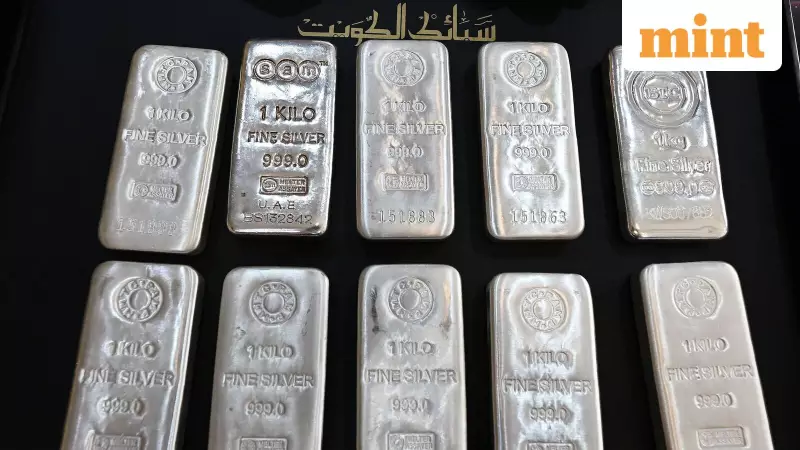
Silver prices have soared to unprecedented levels in international markets, yet India's physical market presents a contrasting picture. The white metal is trading at a significant discount domestically as high prices suppress buyer interest.
Record Overseas Rally Meets Domestic Resistance
International silver prices jumped dramatically, reaching a historic peak of $93.22 per ounce. This translates to approximately ₹9,412 for 31.10 grams. The surge represents a substantial 3.5% increase, with prices even touching $94.1213 during trading.
However, this global rally has not translated to similar strength in India's physical silver market. Trade participants report a stark discount prevailing locally.

A Stark Price Discrepancy Emerges
Surendra Mehta, National Secretary of the India Bullion and Jewellers Association (IBJA), confirmed the situation. "There is a ₹10,000 per kilo discount for bars prevailing in the physical market here," he stated. The IBJA's gold rates are notably used by the Reserve Bank of India for sovereign gold bond redemptions.
Mehta provided a concrete example. Against a standard costing of ₹302,628 per kilogram, a bullion dealer in Mumbai was selling silver at just ₹292,628. This clear discount highlights the demand slowdown at these elevated price levels.
Futures Surge Despite Physical Market Weakness
Interestingly, silver futures contracts on the Multi Commodity Exchange (MCX) tell a different story. The most active contract rose sharply by 5.5%, hitting a record ₹3.03 lakh per kilogram. This move tracked gains in the international market, where prices climbed 5.3%.
Analysts link the global price surge to escalating tariff tensions. Specifically, disputes between the United States and NATO allies concerning Greenland's sovereignty have fueled market uncertainty and buying in precious metals.
Demand Data Reveals a Slowdown
Independent data from Metals Focus, a precious metals research consultancy, supports the observation of cooling Indian demand. Their figures show India imported 6,785 tonnes of silver in the first eleven months of 2025. Total demand for the same period stood at 7,040 tonnes.
Chirag Sheth, Principal Consultant for South Asia at Metals Focus, explained the dynamic. "There is a slowdown in demand here which has resulted in a discount even as the prices have climbed to historic highs," he confirmed.
Despite the current domestic softness, Sheth maintained a bullish outlook for silver. He linked this optimism to persistent global uncertainty surrounding tariffs. "The tariff wars have resulted in a dislocation in silver markets. Unless clarity emerges, tightness in the metal would continue globally and sentiment will remain upbeat," he elaborated.
Silver ETFs Gain Traction Among Indian Investors
While physical demand cools, Indian interest in silver is increasingly channeling through financial instruments. The Nippon India Silver ETF, for instance, saw its price rise 5.66% to ₹284.70 per gram. This brings its year-to-date gains to an impressive 32.45%, with returns over the past year nearing 225%.
This performance starkly outpaces the equity market. The benchmark Nifty index has delivered an absolute return of minus 2.15% year-to-date and 10.3% over the past year.
The shift towards ETFs is significant. Satish Dondapati, a fund manager at Kotak Mutual Fund, highlighted the growth. Assets under management for silver ETFs skyrocketed to ₹72,907.44 crore by the end of December 2025. This marks a dramatic increase from ₹15,339.21 crore recorded on March 31, 2025.
The Indian silver market thus presents a complex duality. Record-breaking international prices and booming futures contrast sharply with discounted physical metal and tempered consumer demand. All eyes remain on global trade tensions, which continue to dictate the metal's volatile trajectory.






