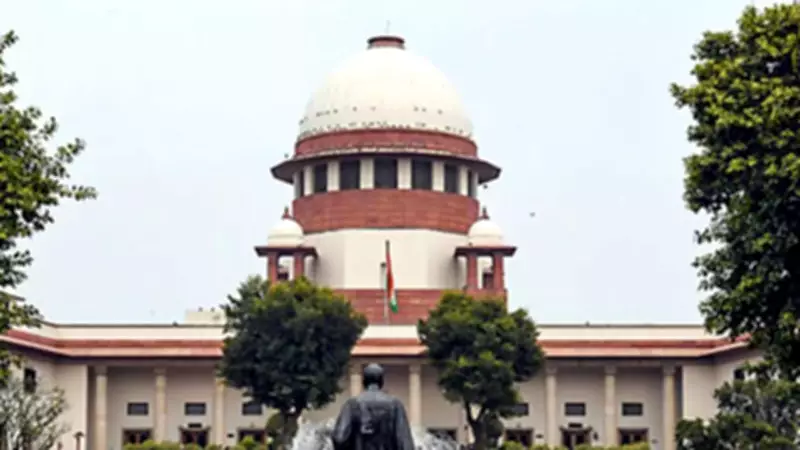
Supreme Court Mandates AI-Based Fraud Detection for All Banking Transactions
In a landmark ruling aimed at curbing the rampant rise of online financial fraud, the Supreme Court of India has issued a decisive directive to all banks across the nation. The apex court has ordered financial institutions to urgently develop and deploy an artificial intelligence-based mechanism designed to automatically flag every suspicious transaction originating from a customer's account.
Immediate Alerts and Transaction Suspension Required
The court's mandate requires that this AI system must immediately issue alerts and, most critically, suspend any flagged transfer until the transaction is fully authenticated and verified directly with the account holder. This robust measure is intended to create a crucial safety net, preventing fraudulent withdrawals before funds are irreversibly lost.
The bench, comprising Chief Justice Surya Kant and Justices Joymalya Bagchi and N V Anjaria, delivered this judgment while expressing grave concern over data presented by the Ministry of Home Affairs. The data revealed an alarming siphoning of nearly Rs 52,000 crore between April 2021 and November 2025 through sophisticated online fraud schemes, including the emerging threat of "digital arrest" scams.

Banks as Trustees, Not Just Profit Centers
The court strongly criticized the current banking paradigm, stating that IT applications developed for seamless transactions cannot be solely profit-oriented. Justice Bagchi emphasized the fundamental duty of banks, remarking, “In the over-anxiety of making profits, banks must realise they are trustees of public money. People have deposited their monies in banks because they trust them. These banks are becoming a huge liability to the public.”
The bench further elaborated that the core problem lies in banks operating predominantly in a business mode. This focus, the court noted, has inadvertently or sometimes connivingly turned them into platforms enabling the swift and seamless transmission of stolen proceeds from criminal activities.
Growing Fraud Cases and Regulatory Action
The court's direction comes against a distressing backdrop of increasing fraud instances, particularly targeting vulnerable groups like senior citizens. There have been multiple reports where bank personnel failed to act despite noticing unusually large withdrawals from the accounts of long-standing, elderly customers.
During the proceedings, Attorney General R Venkataramani informed the court that the Reserve Bank of India (RBI) has already devised a Standard Operating Procedure (SOP) for banks to thwart cyber frauds. The bench has instructed the ministry to thoroughly examine this SOP and formally notify it for pan-India implementation to ensure uniform protection.
Broader Critique of Banking Practices
Chief Justice Surya Kant also highlighted a related systemic issue, noting that courts are increasingly being forced to act as recovery agents for banks. He pointed out instances where bank officials, in alleged collusion with industrialists, grant huge loans recklessly and then utilize legal tribunals like the National Company Law Appellate Tribunal (NCLAT) to recover the money.
The court explicitly asked the RBI to vigorously discharge its duties as the sector regulator to ensure the security of the hard-earned savings of retired individuals and all depositors.
Government's Response and Committee Formation
In response to the "digital arrest" fraud menace, the Attorney General stated that the Home Ministry has constituted a high-level inter-departmental committee. This committee will comprehensively examine all facets related to this specific cybercrime. It will operate under the chairmanship of a special secretary within the ministry, aiming to develop a coordinated national strategy.
This Supreme Court order marks a significant shift, placing a mandatory technological and ethical burden on banks to proactively protect customer assets, reinforcing their role as fiduciaries of public trust in the digital age.