

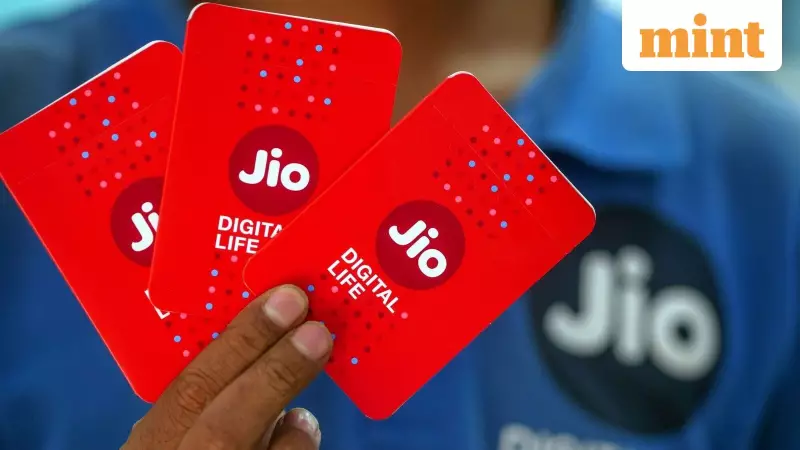
Reliance Jio Confident in Organic ARPU Growth, Sees No Immediate Tariff Hike Need
Reliance Jio Infocomm, India's largest telecom operator by market share, has expressed confidence in organic growth for its average revenue per user (ARPU). The company sees no immediate need for tariff hikes, a stance that contrasts sharply with rivals Bharti Airtel and Vodafone Idea.
ARPU Performance and Growth Strategy
In the December quarter, Jio's monthly ARPU increased by 1.1% sequentially, rising from ₹211.4 to ₹213.7. This growth of 110 basis points reflects a steady upward trend. Over the past year, Jio's ARPU has grown by approximately 5-5.5% without any tariff increases.
Anshuman Thakur, head of strategy at Reliance Jio, highlighted this progress during a recent earnings call. He stated, "We are quite happy with the traction—a 1% quarterly increase in ARPU. We have certain handles to improve ARPU while giving more value to customers, and that's our focus."

Thakur emphasized that organic ARPU growth of 5-6% annually is a strong position for the company. He linked this growth to rising 5G data consumption on Jio's network.
Contrast with Rival Operators
Bharti Airtel and Vodafone Idea have repeatedly called for tariff corrections to boost returns on capital. Airtel argues that Indian telecom tariffs remain among the lowest globally. It advocates for a differentiated pricing structure rather than a one-size-fits-all model.
As of September end, Airtel leads in ARPU at ₹256 per month, while Vodafone Idea's ARPU stands at ₹167. Both companies have yet to announce their December quarter earnings.
The last industry-wide tariff hike occurred in July 2024, after a gap of over two years. Reliance Jio took the lead with increases ranging from 12% to 25%. During that hike, Jio and Bharti Airtel also boosted data allowances in their minimum recharge plans from 1.5 GB to 2 GB per day.
Market Expectations and IPO Timing
Brokerage firm Citi expects the next tariff hike to align with Jio's planned listing in the first half of the current year. Citi has deferred its expectation from December 2025 to June 2026. Jio Platforms, which houses Reliance Industries' telecom and digital services, will file draft papers for its stock exchange listing soon.
Faisal Kawoosa, chief analyst at Techarc, noted, "Jio seems cautious on tariff hikes due to its upcoming IPO. A post-IPO hike could yield substantial gains in share price." He added that Jio might follow if other operators initiate hikes first.
Kawoosa also suggested the need for a tiered pricing structure in telecom, with subsidized plans for lower-income users and premium options for higher strata. This approach could maintain affordability while boosting ARPU.
5G and Data Consumption Trends
Jio reports strong uptake in 5G data consumption. Per capita data usage on its network reached 40.7 GB per month in the December quarter. Total data traffic grew 34% year-on-year to 62.3 billion GB.
Thakur cited a third-party study indicating that Jio users consume 5G 99% of the time on its network, compared to less than 50% on other networks.
Digital Services and Future Plans
Jio's non-connectivity digital services, including cloud, AI, and content, are gaining significance. The company recently partnered with Google to offer the Gemini Pro plan free to users. Brokerage BNP Paribas sees this as a differentiation and monetization opportunity.
Thakur explained that Jio can leverage products from Reliance Intelligence or partners without direct costs, turning customer access into revenue opportunities.
On capital expenditure for data centers and GPUs, Thakur clarified that Reliance or Reliance Intelligence will incur these costs. Jio will access assets through long-term leases to offer services like Jio Cloud.
Home Broadband Expansion
Jio is intensifying its focus on home broadband. Connected premises with fixed broadband increased to 25.3 million in the December quarter. JioAirFiber, its fixed wireless access service, has over 11.5 million subscribers as of December 2025.

The company aims for 100 million home broadband customers, with no specified timeline. It is improving cost efficiency through fixed wireless access, which uses unlicensed band radio technology to serve multiple homes from a single receiver, reducing per-subscriber costs.
Jio's strategy centers on organic growth, enhanced digital services, and strategic timing for future moves, positioning it uniquely in India's competitive telecom landscape.





