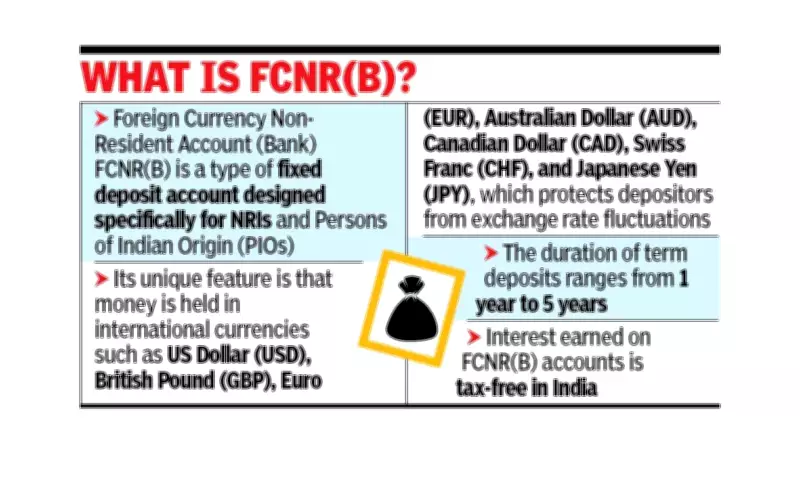
Chennai: After three consecutive years of growth, net inflows under Foreign Currency Non-Resident (Bank) [FCNR(B)] accounts nosedived to $900 million in FY26 from $7.1 billion in FY25. The 87% year-on-year decline, the sharpest since 2022-23, comes despite the rupee weakening over the past year. Meanwhile, major banks have started revising FCNR(B) deposit rates to attract NRI inflows.
RBI Report Highlights Decline
The RBI’s Annual Report for 2025-26, released a fortnight ago, stated that net inflows under non-resident deposits moderated during 2025-26 from a year earlier due to a decline in net inflows under FCNR(B) deposits. Post-Covid, FCNR(B) net inflows revived to $2.4 billion in 2022-23 and rose 166% to $6.4 billion in 2023-24, the report said.
Interest Rate Arbitrage Narrowed
Dharmesh Kant, head of research at Chola Securities, said that in FY25, the Federal Funds rate declined from 5.25% to 4.25%, while FCNR(B) deposit rates offered by Indian banks were in the range of 4.5% to 5%, leaving an interest-rate arbitrage of around 75 basis points.

“The Federal Funds rate during FY26 moved further lower to 3.75% from 4.25%. Consequently, in line with the RBI’s 125-basis-point rate cut, banks lowered FCNR(B) rates to around 3.75%-4.25%, narrowing the interest-rate arbitrage gap to between 50 basis points and zero in many cases, which led to significant outflows from FCNR(B) deposits,” he said.
“However, public sector banks can attract higher net inflows through FCNR(B) deposits by effectively marketing the product among NRIs,” he added.
IOB Revises Deposit Rates
Public sector lender Indian Overseas Bank (IOB) revised its FCNR(B) deposit rate to a flat 6.5% per annum on US dollar deposits across three- to five-year tenures with effect from June 15, 2026.
“For Indians living abroad, this is a good moment to bring their savings home in a way that earns well and stays safe from currency swings. The diaspora has banked with us for generations, and we want every NRI to feel that IOB is still the most natural home for their foreign-currency savings,” IOB managing director and CEO Ajay Kumar Srivastava said in a statement.
Geopolitical Factors Play Minor Role
Anand Rathi Wealth observed that geopolitical developments affected NRI sentiment, but these were not the primary reason for the fall in FCNR(B) inflows.
“Still, the West Asia conflict did create some uncertainty, especially for Indians working in the Gulf region. In March 2026, amid US-Iran tensions, around $2 billion was withdrawn from Indian bank accounts. Many investors were cautious about oil prices and potential disruptions in the Strait of Hormuz, prompting some NRIs to maintain higher liquidity levels. Overall, geopolitical developments did have an impact, but the decline in FCNR(B) inflows was primarily driven by interest-rate and regulatory factors rather than geopolitical risks alone,” said Shweta Rajani, associate director at Anand Rathi Wealth.
Positive Outlook for FY27
According to Sanjit Singh Paul, smallcase manager and managing partner at Modulor Advisory Services (Modulor Capital), the macroeconomic environment is beginning to show subtle tailwinds that support a positive outlook for FCNR(B) inflows in FY27.
“The easing of the West Asia crisis has brought much-needed relief to global oil prices, which has subsequently helped stabilise broader financial markets. By officially stepping in to absorb the nearly 3.5% currency-hedging costs that previously burdened the banking sector, the RBI has allowed FCNR(B) interest rates to rise to highly competitive levels. This policy move restores the interest-rate arbitrage that many NRIs seek,” he said.