Bengaluru: Namma Metro services have been disrupted three times within a month, with heavy rain and gusty winds causing operations to halt twice on parts of the network. The latest incident occurred on Tuesday, when a tree branch fell on the track between ITPB and Sathya Sai Hospital stations, stranding commuters for nearly 30 minutes. Services between Whitefield and Garudacharpalya were suspended, affecting passengers across 10 stations on the busy Whitefield corridor during peak evening hours.
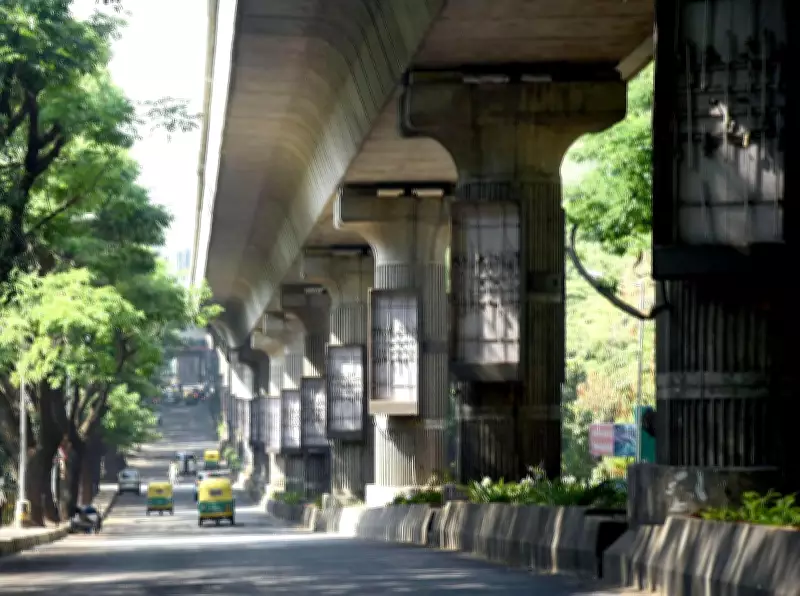
Commuters have questioned why the Bangalore Metro Rail Corporation Limited (BMRCL) did not take preventive measures, such as pruning tree branches dangerously close to the elevated tracks. BMRCL officials stated that approximately 890 trees are located near elevated viaducts on the Challaghatta–Whitefield and Silk Institute–Madavara corridors. Among these, around 100 trees stand within 10 meters of the tracks. Officials maintained that periodic pruning is carried out to address operational risks posed by trees during heavy rain and strong winds.
Tree Density and Pruning Efforts
On the Purple Line, 523 trees are located close to the viaduct, with 35 within 10 meters. The Green Line has 370 trees near the viaduct, including 71 within 10 meters. Officials claimed that on the elevated section of the Yellow Line from RV Road to Bommasandra, trees do not pose operational risks. A BMRCL official explained that pruning of trees near Metro viaducts is performed periodically, especially before the monsoon, to prevent branches from falling onto tracks during adverse weather.

“On May 27, a small tree log fell on the track between ITPB and Sathya Sai Hospital stations on the Purple Line. As per standard operating protocol, train services on the affected stretch were temporarily suspended until the obstruction was removed and track safety inspections were completed,” the official said.
Operational Safety Protocols
A senior BMRCL official noted that Namma Metro operates on a 750-volt DC third-rail traction system, which supplies electrical energy to trains. “Any foreign object on the track cannot be ignored. If it comes in contact with the train or the third-rail power supply system, it can lead to operational and safety risks. To avoid major disruptions, services are halted immediately and resumed only after inspections are completed,” the official added.
During thunderstorms with strong gusty winds, the Operational Control Centre (OCC) follows standard procedures, directing loco pilots to reduce train speeds on elevated sections as a safety measure. On May 21, heavy rain and gusty winds delayed services on all stretches after metal sheets from nearby structures blew onto the tracks, causing disruptions.
The official added that daily inspections of the 750V DC third-rail traction system, including fittings and related components, are conducted to ensure safe operations. Automated pumps installed in underground sections drain rainwater and prevent accumulation, helping to maintain uninterrupted services during heavy rain.