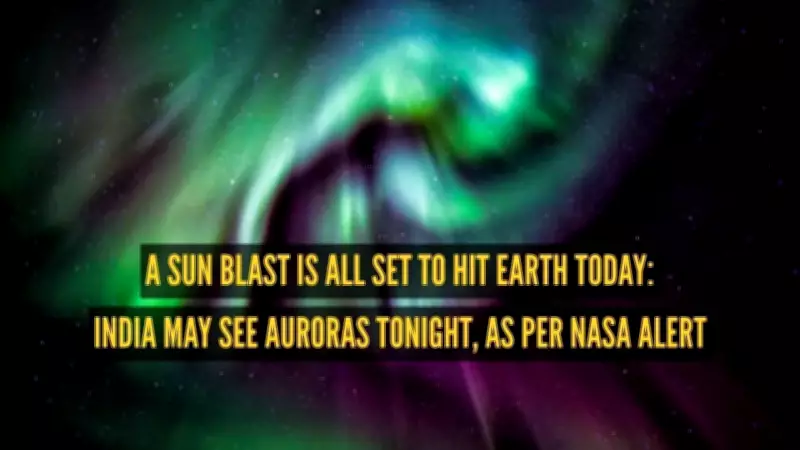
The sun has been exceptionally active all week, unleashing a series of flares and coronal mass ejections. Now, a powerful explosion from a region called Active Region 4461 is set to impact Earth. This M1.8-class flare, a mid-range event on the solar flare scale, has sent a filament of magnetized gas hurtling toward our planet at approximately 1,400 kilometers per second. The coronal mass ejection (CME) is expected to reach Earth today, potentially triggering a geomagnetic storm.
A Welcome Solar Storm
The Space Weather Prediction Centre (SWPC), the U.S. agency responsible for monitoring solar activity, has issued a watch for a G3 or stronger geomagnetic storm. A geomagnetic storm is a temporary disturbance of Earth's magnetic field caused by a surge of solar energy hitting the magnetosphere. For the average person, this means a good chance of witnessing the aurora borealis, or northern lights, in the northern hemisphere. These stunning curtains of green, purple, and red light occur when charged solar particles collide with gases in Earth's atmosphere. According to NASA, parts of northern India, central Europe, the northern United States, southern Australia, and New Zealand could see striking displays of light tonight.
Understanding the Science
The solar flare attack began on June 6, when Active Region 4461 erupted, producing an M1.8-class solar flare. This massive burst of X-ray radiation caused minor radio disruptions on Earth. It was followed by a coronal mass ejection (CME), a massive burst of plasma and magnetic fields from the Sun, directed toward Earth. The CME is now expected to cause a geomagnetic storm between June 8 and 9. Geomagnetic storms are rated on a scale from G1 (minor) to G5 (extreme). A G5 storm in May 2024 knocked out power grids and sent auroras blazing across the country.

Viewing the Aurora in India
In India, the best chances of seeing the aurora lie in high-altitude northern regions, provided local atmospheric conditions remain clear. Ladakh, Spiti Valley in Himachal Pradesh, parts of Uttarakhand, and Arunachal Pradesh offer the best viewing points. The optimal time to spot auroras is usually between 10 PM and 2 AM IST, with the peak window from 11 PM to 1 AM IST.
How to See the Aurora Borealis
No special equipment is required to watch the bright lights. Find a dark area with a clear view of the northern horizon, and allow your eyes to adjust to the darkness. For those looking to capture the view, use manual camera mode with ISO between 1600 and 6400 and a shutter speed of 10 to 25 seconds. However, keep in mind that celestial predictions don't always come true, and the night could turn out to be a normal one.