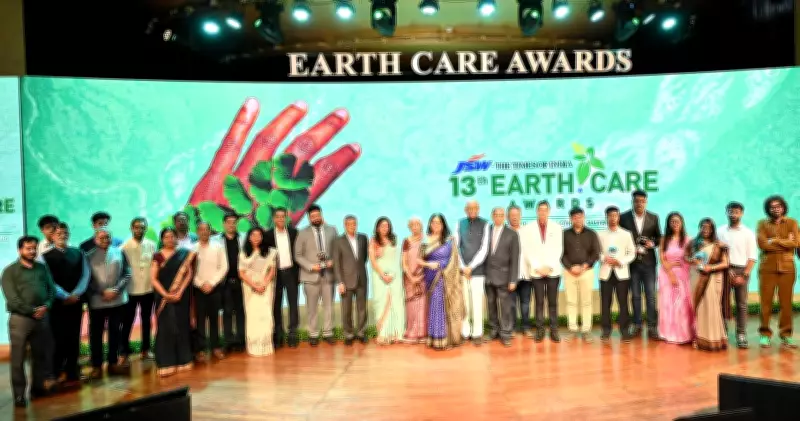
The Young Climate Champions Programme continued to expand its influence this year, reaching a broader network of environmentally conscious youth across India. As sustainability and environmental responsibility become central to discussions about India's future, young people are emerging as a formidable force in the nation's climate movement. With the world's largest youth population and an average age of just 29, India is uniquely positioned to cultivate a generation of climate-aware citizens capable of driving meaningful change while contributing to economic growth and development.
Programme Expansion and Reach
Recognising this potential, the 13th edition of the Earth Care Awards introduced the second edition of the Young Climate Champions Programme, building on the encouraging response from its inaugural year. The initiative engages young minds through specially designed workshops conducted across colleges nationwide. Its primary goal is to identify and recognise innovative climate solutions that can be implemented and replicated to generate a positive impact on the environment and local communities.
This year, the programme scaled up significantly in terms of outreach and scope. It reached across 25 states and three Union Territories, engaging more than 250 educational institutions. Through college connect initiatives, organisers raised awareness about sustainability challenges and motivated students to participate in the Earth Care Awards. Participating institutions included Delhi Technical University, St. Xavier's College of Arts and Science (Kozhikode), NIT Kozhikode, IIT Gandhinagar, TISS Guwahati, The National College (Bengaluru), IIT Roorkee, Hansraj College (Delhi), IIT-BHU, IIT Guwahati, IIM Kozhikode, IIM Udaipur, IIT Delhi, St. Xavier's College (Ranchi), and Symbiosis College of Arts and Commerce (Pune), among others.

Growing Youth Interest
The response highlighted increasing enthusiasm among Indian youth for sustainability and environmental leadership. The jury received applications from 750 students and 250 institutions nationwide, underscoring the rising participation of educational institutions in climate-focused initiatives. Awards were presented across six key categories: Air Quality Improvement and Pollution Control, Biodiversity and Ecosystem Restoration, Clean and Renewable Energy Solutions, Environmental Education and Public Engagement, Sustainable Waste Management and Circular Economy, and Water Stewardship and Resource Management. Earth Day Network India served as the outreach partner for the programme.
At a time when climate concerns are becoming increasingly urgent, the Young Climate Champions Programme positions India's youth not just as participants in sustainability efforts but as future leaders capable of shaping a greener and more resilient future.
Jury and Key Figures
The jury comprised notable figures including Harshita Umesh (Founder, Vaada Hope Foundation), Ananya Bhattacharya (Director, Banglanatak.com), Vidya Bhushan Kumar (former Principal Chief Conservator of Forests), Animesh Kapoor (Director, Eco Roots Foundation), Deeksha Prakash Singh (Young Energy Expert, UNECE), Shweta Dalmmia (Founder, Bharat Climate Startups), Ram Bhooj (Senior Advisor, UNEP), Anuradha P Dhawan (Sustainable Fashion Designer), Devangshu Dutta (Environmental Coordinator, The Satsang Foundation), and Rituraj Phukan (Climate Reality Leader).
Sangita Jindal, Chairperson of JSW Foundation, stated: "The climate is changing, and the evidence is impossible to ignore. Yet, amid this crisis, there is hope. Young women and men are not waiting for change; they are becoming the force driving it." Ashwini Bhide, Municipal Commissioner of BMC, emphasised the need for collective responsibility: "Building a climate-resilient Mumbai requires collective responsibility from government, institutions, businesses, and citizens alike."

Award Winners
- Rajalakshmi Institute of Technology, Chennai (Category: Climate-Resilient Campus) – Recognised for institutional leadership in green infrastructure, renewable energy, environmental education, and youth engagement.
- Rinku Pal, ABM College (Category: Air Quality Improvement and Pollution Control) – Honoured for the "Vayuveer Program," a youth-led initiative addressing waste management and indoor air pollution in informal settlements.
- Jhansi Bhupendra Pulla, Pillai College of Arts, Commerce and Science (Category: Biodiversity and Ecosystem Restoration) – Recognised for the "Pollinator Highway" initiative creating ecological corridors for pollinators.
- Arnav Garg, IIT Delhi (Category: Clean and Renewable Energy Solutions) – Recognised for an AI-enabled Smart Grid Intelligence Platform enhancing renewable energy integration.
- Haridra Bora, Miranda House (Category: Environmental Education and Public Engagement) – Honoured for climate-sensitive health risk mapping to improve early warning systems for mosquito-borne diseases.
- Arpit Kumar, Manipal Academy of Higher Education (Category: Water Stewardship and Resource Management) – Recognised for MARU® powered by METAL®, a maintenance-free water purification technology.
- T.K. Devanarayanan, NIT Calicut (Category: Sustainable Waste Management and Circular Economy) – Honoured for a decentralised circular bio-refinery model transforming poultry and meat waste into biodiesel, bioplastics, and biogas.
Programme Outreach
The initiative covered 25 states and three Union Territories, reaching over 4.5 lakh individuals. It received 750 student entries from 250 institutions, with 25,000 students participating in 200 sessions led by 50 speakers.
Disclaimer: Content produced on behalf of JSW.