The Russia-India-China (RIC) format has resurfaced in diplomatic discourse following Russian President Vladimir Putin's recent remarks during a meeting with news agencies in St Petersburg. Responding to an Indian journalist, Putin warmly described India as a reliable partner, praised its economic growth and independent foreign policy, and dismissed as futile the pressure on New Delhi to reduce cooperation with Moscow. On India-China relations, he declined to interfere, calling it a sensitive and multifaceted relationship. Regarding Pakistan, he rejected the notion that it had fallen under China's sway, reflecting Moscow's desire to maintain working relationships across South Asia. While little of what Putin said was new, his words bear attention.
Putin's Recollection and RIC's Origins
Putin noted that the RIC format was elevated to summit level in St Petersburg in 2006 and eventually gave rise to BRICS. This remark has generated renewed interest in the trilateral. With Moscow seeking to preserve strategic space amid sharpening great-power rivalry and India uneasy about Russia's growing dependence on China, revisiting RIC's relevance for India becomes timely.
The RIC idea has always been Russia's. It originated with academician Yevgeniy Primakov, who envisioned the RIC as a counterweight to US dominance. He gave it public voice during his visit to New Delhi in December 1998 as Prime Minister, speaking of the need for a strategic triangle to ensure regional peace and stability. His words grabbed headlines, voiced when India was under US sanctions for its nuclear tests in May 1998.

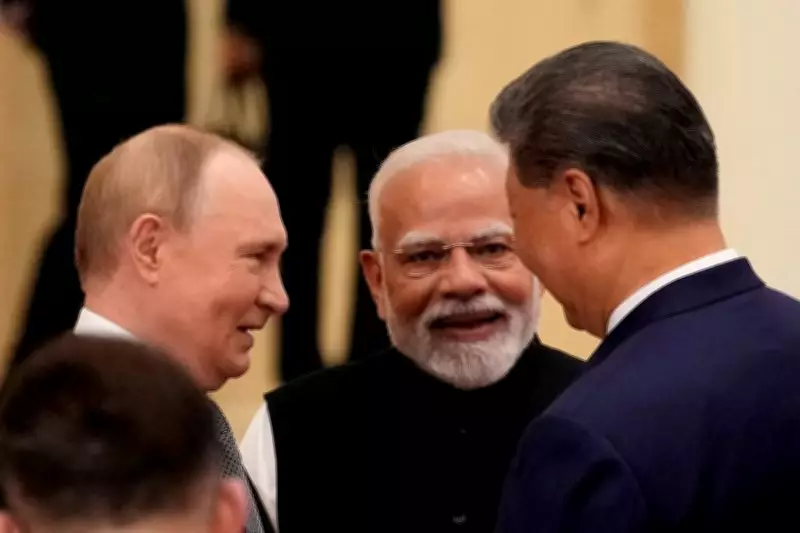
The first RIC foreign ministers' meeting was held in New York in 2002, with the understanding that bilateral issues would remain outside the trilateral's remit. Putin convened the first RIC summit in St Petersburg in 2006 on the sidelines of the G8 summit. At Russia's instance, BRIC (and soon BRICS) followed, and as the latter gathered stature, the trilateral receded into the background. After a hiatus, two RIC summits were held alongside the G20 summits in Buenos Aires (2018) and Osaka (2019), attended by Prime Minister Narendra Modi, President Xi Jinping, and President Putin. A brief, orchestrated Modi-Putin-Xi interaction at the SCO summit in Tianjin in 2025 attracted huge attention after images of the three leaders in relaxed conversation went viral. Nonetheless, the RIC has remained largely dormant in recent years, though Track-II dialogues among academics have continued.
Structural Differences Limiting RIC's Evolution
The RIC's limited evolution derives from structural differences in how the three countries view the emerging international order. All three favour a multipolar world, but priorities differ. Russia and China seek a reduction in US dominance, while India looks for a larger role for itself rather than a diminution of American primacy. Russia, and separately China, regard the US as their principal strategic competitor; for India, it is China. That divergence influences India's caution as the RIC brings India into a trilateral framework with the very power it regards as its long-term strategic challenge and does so in a triangle where Russia and India are comparatively weaker members.
India's caution also reflects its complex, at times adversarial, relationship with China. Among its concerns are the unresolved dispute over the Line of Actual Control, China's baseless claims on Arunachal Pradesh, its growing strategic presence in India's maritime neighbourhood, the China-Pakistan Economic Corridor passing via Indian territory, and Beijing's opposition to India's aspirations for Nuclear Suppliers Group and UN Security Council membership. Meanwhile, Moscow has a growing interest in stable India-China relations, in keeping trilateral channels open, and preserving equilibrium among the three.
Russia's Evolving Calculations
Russia's calculations have evolved somewhat differently since its confrontation with the West over Ukraine. Successive rounds of western sanctions since 2014 have pushed Moscow closer to Beijing, widening the asymmetry in their relationship. China has meanwhile steadily expanded its strategic and economic influence in Central Asia, which Russia regards as its 'near abroad'. This has made Moscow's interest in equilibrium more compelling.

Their differing perspectives are also reflected in how they approach multipolarity. During Putin's recent visits to both Beijing and New Delhi, the idea of a multipolar world was endorsed in bilateral declarations. Yet the India-Russia joint statement of December 2025 went further, committing the two countries to a multipolar Asia as well. The Russia-China joint statement issued in May 2026 contains no comparable formulation. For India and Russia, multipolarity cannot stop at the global level. It must extend to Asia, ensuring that the region's future is shaped by several centres of influence rather than one dominant power.
India-Russia Partnership Remains Vital
Equally, Russia's growing partnership with China should not obscure the continuing importance of the India-Russia special strategic partnership, which encompasses numerous sensitive sectors and remains a major pillar of India's foreign policy. Nor should closer Russia-China ties be mistaken for complete alignment, as Moscow and Beijing retain distinct, and at times conflicting, national interests. India and Russia have traditionally favoured diversified external relationships over exclusive alignments, reflected in India's policy of multi-alignment and Russia's longstanding concept of multi-vector diplomacy. That reality is not altered by India's differences with China, nor by its expanding ties with the US. Weakening the partnership serves neither country's interests. It would diminish the strategic options available to both, while drawing Russia closer to China and creating additional space for Pakistan.
How India Should Approach RIC
How, then, should India approach the RIC now that Putin's remarks have revived discussion about it? It should do so with the discipline that characterises Indian statecraft. The RIC remains useful precisely because it is limited. The geopolitical realities that prevented it from evolving into a more strategic grouping two decades ago remain and are, in some respects, even more pronounced.
India should engage within the trilateral for what it realistically offers: a forum for dialogue on select multilateral issues, a modest hedge in a world of shifting alignments, and a rare channel through which India, Russia, and China can exchange views even when one of the bilateral relationships is under strain. Beyond that, expectations should remain modest.
India's strategic autonomy and multi-alignment rest on maintaining ties across competing centres of power, always on its own terms. Putin's remarks on the RIC should be viewed as a reminder that in an era of shifting alignments, even limited forums retain value. India benefits from keeping every useful diplomatic channel open while remaining firmly anchored in its own interests.