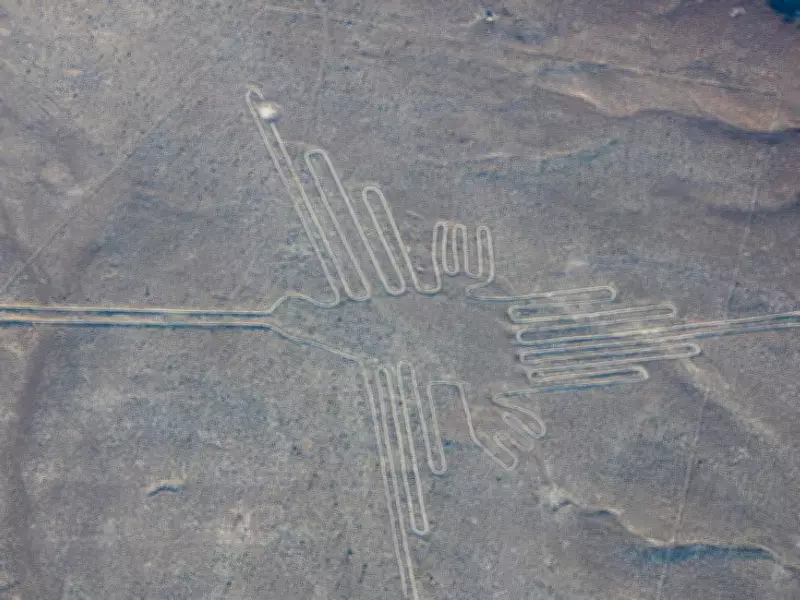
The Nazca Lines, sprawling across the dry pampas of southern Peru, are best known from an aerial perspective. These immense geometric patterns and animal-like figures are etched into the earth. However, their entry into modern archaeology did not begin from an airplane cockpit. The story started on foot under the scorching desert sun in 1927, when Peruvian archaeologist Toribio Mejia Xesspe noticed something unusual while walking through the surrounding hills.
The Discovery from Ground Level
Mejia Xesspe observed large, intentional designs on the slopes, not random scratches. He was experiencing a massive design integrated into the physical environment, revealing the context in which it was made and used. The geoglyphs were created by removing the iron oxide-colored dark stones that covered the desert surface, exposing the paler underlying soil. These markings have survived due to the region's extreme aridity, with little rainfall and low erosion.
Challenges of Ground-Level Observation
From ground level, the lines rarely resolve into recognizable animals; they often appear as long roads or disorienting lines. The human eye detects only glimpses: large dirt roads and extended lines that are confusing over sand. NASA’s Earth Observatory notes that contrast makes the designs visible from a distance, but the landscape can be deceptive at ground level. The designs require a view from above to appreciate their full form.

A Shift in Interpretation
Early explorers quickly concluded that the lines were made to attract the gaze of gods above or even for ancient aviators. However, a ground-level perspective alters the story. The geoglyphs transform from a speculative sky-viewing theory into a more human tale of movement, landscape, and community. Low-level perspectives suggest that the lines were not only passive images to be observed from afar. Archaeological evidence indicates that some lines may have been walked, used as pathways for rituals or processions.
Support from Modern Research
This change in perception is backed by recent field studies. A study by the University of Bristol, published in the journal Antiquity, suggests that at least some Nazca features served as vital aspects of ancient navigation across the land, acting as markers and routes for rituals or processions. The desert floor becomes a walkthrough that reveals patterns and experiences that an aerial perspective does not capture.
The Legacy of Toribio Mejia Xesspe
Toribio Mejia Xesspe (April 16, 1896 – November 2, 1983), a Peruvian archaeologist and student of Julio Cesar Tello, was an early documented observer. Historical records show his observations between 1926 and 1927, and experts agree that his trained eye saw what thousands of travelers had missed. His work brought ground-level observation into scientific research.
Lessons from the Nazca Lines
The Nazca Lines teach us how scale can deceive perception. From one perspective, a feature appears small and unimportant; from another, it is part of a vast, purposeful layout. The lines balance visibility and concealment, fully visible only with the correct perspective, lighting, and speed. Part of their appeal is resisting easy interpretation—they are obvious yet elusive. Mejia Xesspe's observations raised new questions, prompting further archaeological investigation. These lines were not messages for the sky but a living, moving experience that showed how ancient civilizations interacted with the earth under their feet.
About the Author: TOI Science Desk
The TOI Science Desk is an inquisitive team of journalists ceaselessly delving into the realms of discovery to curate a captivating collection of news, features, and articles from the vast world of science for The Times of India readers. Consider us your scientific companion, delivering a daily dose of wonder and enlightenment. Whether it's genetic engineering, space exploration, or artificial intelligence, the TOI Science Desk ensures you stay connected to the pulse of the scientific world. We are storytellers of scientific narratives, committed to demystifying science and making it accessible and engaging for all backgrounds.