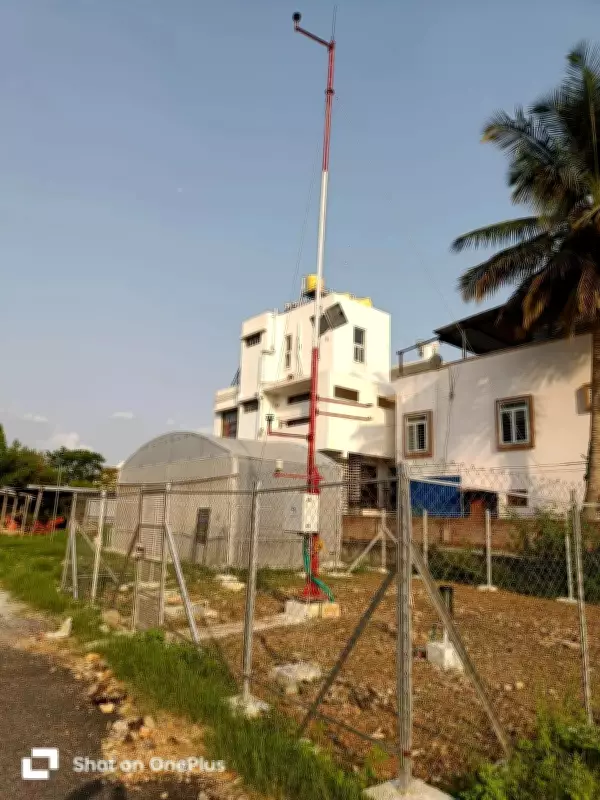
The India Meteorological Department (IMD) has set up an Automated Weather Station (AWS) for agriculture at the ICAR Taralabalu Agricultural Science Centre in Davanagere, and it is ready to commence operations. It became operational on June 1 and will provide services related to rainfall, wind, humidity and temperature.
Background and Significance
The Karnataka State Natural Disaster Monitoring Centre and the Hiriyur Agricultural and Horticultural Research Centre currently provide weather information and forecasts for Davanagere district. For the first time, the Indian Meteorological Department (IMD) has established an agriculture-focused weather station in the district, making it easier to gather accurate and localised data.
Centre Management and Functionality
“We have provided the necessary space for the AWS. The installation of sensor-based equipment has been completed and is already functioning. The information generated by the equipment will be automatically transmitted to the IMD website. We are only responsible for overseeing the centre,” said TN Devaraj, head of the ICAR Taralabalu Agricultural Science Centre.

The centre is equipped with automated instruments to measure rainfall, wind speed, humidity levels and temperature. These instruments will transmit environmental data from the surrounding area every 15 minutes. Based on this data, an analysis will be made, helping in taking precautionary measures related to agricultural activities.
Benefits for Agriculture
“Generally, during high temperatures, there is a higher infestation of sap-sucking pests. Accurate data will be available to advise farmers on pests and diseases. By observing annual rainfall trends, it will be possible to assess groundwater levels. Analysis of how much evaporated water returns to the ground as rainfall will also help in framing agriculture-related policies,” Devaraj explained.
Existing Monitoring Infrastructure
The Karnataka State Natural Disaster Monitoring Centre has 206 rainfall measurement centres and 30 weather monitoring centres in the district. The state government has set up one rainfall measurement centre for each gram panchayat. Similar centres are also present in several urban areas. Weather monitoring centres provide data on temperature and wind speed. Based on this information, the agriculture department issues advisories and forecasts to farmers.