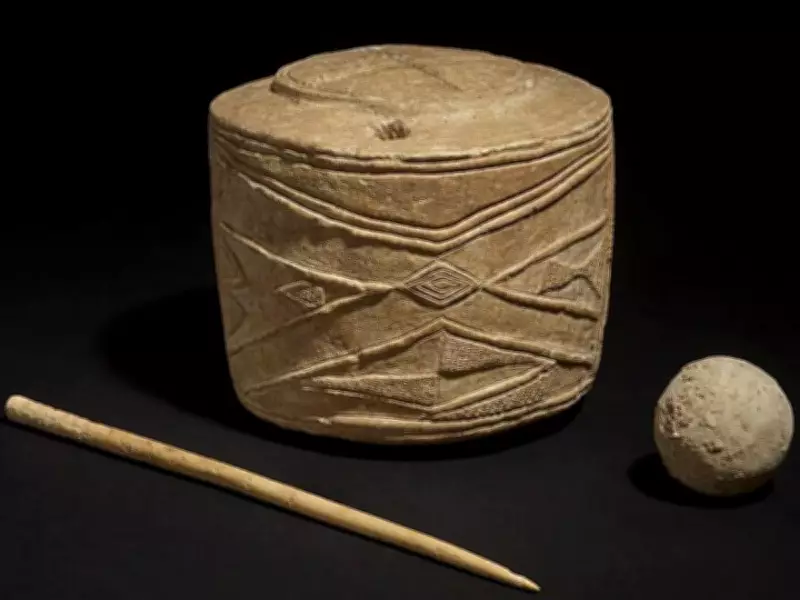
Archaeologists excavating a burial mound in East Yorkshire in 2015 made a remarkable discovery that has reshaped understanding of a long-standing archaeological puzzle. The grave contained the remains of three children along with a carved chalk drum, dated to approximately 3005–2890 BC. This object is a rare prehistoric artifact closely linked to the famous Folkton drums, which were first unearthed in the 19th century.
Significance of the Burton Agnes Burial
The burial at Burton Agnes attracted significant attention from archaeologists due to the rarity of chalk drums. This find placed one of these enigmatic objects in a social and burial context that had not been observed before. The original Folkton drums, discovered in 1889, have long been admired for their intricate carvings, but their purpose remained elusive, according to University College London (UCL).
While the discovery did not solve the mystery entirely, it provided researchers with new evidence regarding who used the drums and why they were placed in graves. In archaeology, the context of an object is as important as the artifact itself. As part of a deeply human story involving a child burial, this carved chalk drum cannot be dismissed as a mere oddity. It linked the object more clearly to Neolithic craft traditions and funerary practices in Britain.

From Grave Object to Potential Measuring Tool
The East Yorkshire chalk drums are remarkable both for their rarity and the care with which they were crafted. Their actual use remained a complete mystery for over a century. However, a study conducted by UCL and the University of Manchester proposed a new interpretation. The researchers argued that these drums may have served a functional purpose beyond being symbolic grave goods.
The authors propose that the drums could have functioned as measuring tools, based on their repeated sizes, circumferences, and proportional relationships. A standard unit of measurement could be established by winding a fixed number of turns of a cord or similar material around each drum, the study suggests. This idea is significant because it gives the objects a possible practical function, rather than solely a ritual role. It also helps explain why their shapes and dimensions are so consistent across different examples.
If the drums were used for measuring, it would indicate that a tool related to planning or construction was deliberately included in burial rites. This object straddles the boundary between everyday practical life and ancient ritual.
What One Secure Find Can Add
The discovery at Burton Agnes has prompted archaeologists to reconsider how early communities organized space and dealt with objects that were both useful and meaningful. Part of what made the 2015 find so important was the longstanding mystery surrounding these items. It was a new member of a small group, but more than that, it reopened a question that had gone unanswered for over a century of museum display and academic discussion.
The new drum was significant because it was found in a secure burial, not recovered as a stray find. This gave archaeologists the rare opportunity to compare the object, the bodies, and the setting all in one location. The combination suggested that the object had a role worth marking in death, as in life. The discovery led researchers to view the drums not as isolated oddities but as part of a larger prehistoric system.
One burial can revive a question that has persisted for more than a century, if it preserves the right combination of objects and people. Three children and a carved chalk drum allowed revisiting an artifact group that had resisted easy answers since the 1800s. The East Yorkshire burial did not solve the case, but it demonstrated how interpretations of the past can change when a rare object is found in the right context.