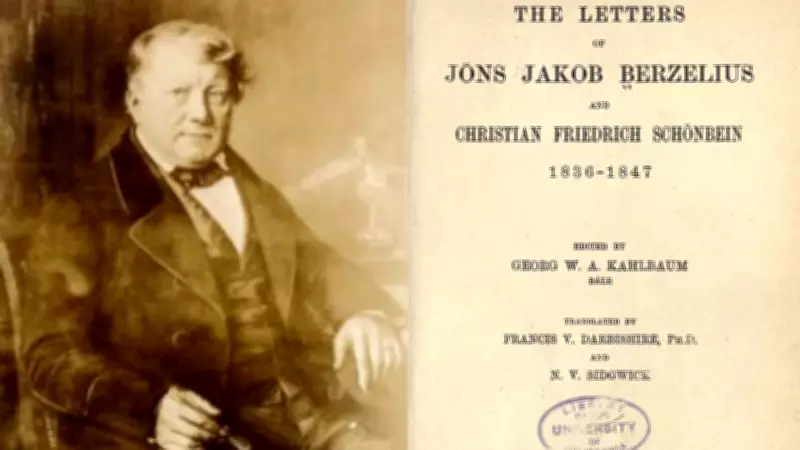
In the history of science, some of the most remarkable discoveries have occurred entirely by accident. One such extraordinary fluke took place in 1846 when Christian Friedrich Schönbein, a German-Swiss chemist, inadvertently transformed his wife's cotton apron into a highly potent explosive. While conducting experiments, he accidentally spilled a mixture of nitric and sulfuric acids and used the apron to wipe up the mess. After hanging it near a stove to dry, he witnessed a stunning phenomenon: instead of merely drying, the apron essentially vanished in a flash. This incident led to the discovery of guncotton, also known as nitrocellulose, a material that would go on to revolutionize fields such as explosives, military technology, photography, medicine, and materials science for decades to come.
How a Simple Cotton Apron Became One of the World's Most Powerful Explosives
According to reports in Electrochemical Science Advances and Schönbein's correspondence with other scientists, he discovered guncotton right in his home laboratory in Basel, Switzerland. The cotton from his apron came into contact with a mixture of concentrated nitric and sulfuric acids, which chemically transformed it into nitrocellulose. This process altered the structure of cellulose, the natural polymer that makes up cotton. The key difference was that nitrocellulose gained nitrate groups, providing an internal source of oxygen that allowed it to burn extremely rapidly. Historical accounts describe Schönbein's new cotton as burning so quickly that it seemed to disappear. Scientists were amazed by the amount of energy it released compared to traditional black powder, while producing far less smoke.
In a letter to physicist Michael Faraday dated February 27, 1846, Schönbein wrote: "I have of late also made a little chemical discovery." This seemingly modest finding would go on to make a tremendous impact on nineteenth-century chemistry and beyond.

Why Guncotton Transformed Warfare, Industry, and Modern Science
Schönbein quickly patented his discovery and demonstrated guncotton to scientists across Europe. This new material outperformed conventional gunpowder in several ways: it delivered more power, generated less smoke, and burned faster. It could be used both as a propellant for firearms and as an explosive charge. According to a 1909 article in Nature titled "Improvements in Production and Application of Guncotton and Nitroglycerine," Schönbein discovered guncotton in 1846. The substance went on to change the nature of warfare in the nineteenth and twentieth centuries by enabling the development of smokeless propellants.
Over time, researchers learned to manufacture nitrocellulose more safely, allowing its use in rockets, ammunition, and other explosive devices. However, in the early days, producing guncotton was extremely hazardous because the material could detonate unpredictably if handled improperly. Thus, while the advantages were remarkable, safety remained a significant concern initially.
The Surprising Legacy of the Accidental Discovery Still Shapes Modern Life Today
Guncotton's influence extends far beyond explosives. Nitrocellulose proved essential for early photographic films, medical bandages, collodion (used in wound dressings), printer's ink, wood finishes, and various modern industrial products. Thus, it played a crucial role in numerous fields, not just military applications.
In the history of polymer chemistry, many scientific studies highlight nitrocellulose as one of the first major successes in modified polymers. According to the American Chemical Society, Schönbein transformed ordinary cotton into a nitrated cellulose that burned rapidly. This not only created a fascinating new material but also paved the way for countless industrial uses.
Almost 185 years later, that kitchen accident in Switzerland remains a classic example of serendipity in science. What began as an attempt to clean up a laboratory mess ultimately changed the course of chemistry, manufacturing, and military technology worldwide.