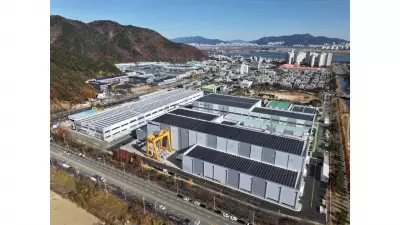
Hyderabad has transformed from a secondary IT/ITeS location into a hyperscale and AI infrastructure hub, with its live IT capacity more than doubling to 151.4 MW by the end of 2025, up from 60.9 MW in 2022, according to Knight Frank India.
Committed Pipeline Ranks Second Only to Mumbai
The city now boasts a committed and early-stage development pipeline of 1.9 GW, placing it second only to Mumbai, Knight Frank stated in its report, 'India Data Centre Market Update 2025: Tracking Capacity, Demand and Supply Pipeline'. Mumbai's committed pipeline expanded to 1,543.3 MW by Q4 2025, while its early-stage pipeline crossed 2,209 MW, reinforcing its position as the country's primary hyperscale hub. Mumbai already has 173 MW under construction, adding up to 3.9 GW.
Key Drivers: Cost Advantage and Government Support
The realty consulting firm noted that the pipeline is driven by operator preference for large, campus-scale deployments and Hyderabad's positioning as a cost-competitive alternative to coastal markets. Telangana's push to become a global AI data centre hub, including incentives for high-density graphics processing units, large-scale training compute, and liquid cooling, along with initiatives like the government's Future City and AI City, is strengthening the city's appeal for next-generation workloads.

Knight Frank also highlighted Hyderabad's disaster-safe geography as a site-selection advantage, with NTT and AdaniConneX aggressively expanding their footprints, even as global hyperscalers step up their presence.
Major Hyperscalers Expand in Hyderabad
Microsoft is set to launch its India South Central data centre region in Hyderabad in 2026. Amazon Web Services already operates three availability zones in Hyderabad, accounting for 46% of the city's live IT capacity. Oracle currently delivers cloud services through a colocation-based deployment and has announced plans to launch a data centre in the city to expand its capacity in India.
Demand Shifts Towards Hyperscale
Demand dynamics are changing. Hyderabad recorded take-up of 19.2 MW in 2024, reflecting a shift towards hyperscale-led absorption. While absorption moderated in 2025, vacancy averaged 23%, indicating the market is in a build-out phase ahead of anticipated AI-driven demand.
Viral Desai, International Partner and Senior Executive Director of Occupier Strategy & Solutions, Industrial & Logistics, Capital Markets & Retail at Knight Frank India, said, “India's data centre growth story is increasingly becoming a tale of regional specialisation. While Mumbai continues to anchor hyperscale deployments owing to its connectivity advantages, Hyderabad is emerging as a preferred AI infrastructure destination, and Chennai is strengthening its role as a strategic gateway for international data traffic from east. At the same time, Vizag has rapidly emerged as one of India's most active greenfield data centre markets, attracting gigawatt-scale development proposals backed by government support, availability of sizeable land parcels and planned subsea cable connectivity.”
National Picture: India's Live IT Capacity Surpasses 1.6 GW
Nationally, live IT capacity across India's seven primary data centre markets surpassed 1.6 GW by end of 2025, with India adding 371.5 MW of live capacity in 2025 after adding 361.6 MW in 2024, signalling a sustained, pipeline-led growth cycle.
Shishir Baijal, International Partner, Chairman and Managing Director, Knight Frank India, said, “The Indian data centre sector is no longer merely expanding — it is structurally transforming. AI-led workloads, hyperscaler investments, sovereign data requirements and cloud adoption are collectively accelerating demand for high-density digital infrastructure across India. What distinguishes the current cycle is the sheer depth of the development pipeline and the strategic diversification into emerging corridors beyond traditional hubs.”