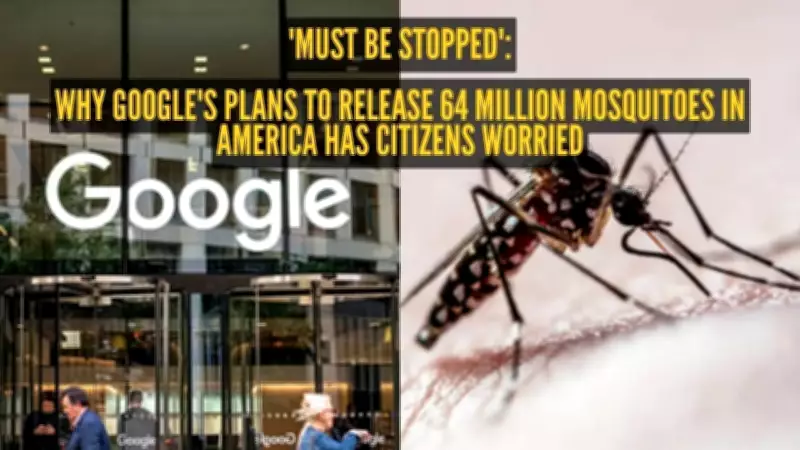
Dengue, chikungunya, and Zika are diseases caused by one type of insect: mosquitoes. According to The Debug Project, backed by Google's parent company Alphabet, mosquitoes kill more people than every other animal combined. 'One species, Aedes aegypti, carries diseases such as dengue, Zika, yellow fever, and chikungunya which make hundreds of millions of people sick every year. And these diseases are spreading faster than ever,' says the project.
While one might believe that a preventative environment or healthy lifestyle would be the ideal solution, the project proposes releasing 64 million mosquitoes in America as the best way forward.
Meet Wolbachia
Alphabet Inc's life sciences wing, Verily, has been breeding 'good' mosquitoes for the past 10 years under its Debug programme. Now, it is seeking permission to release these millions of good bugs in California and Florida. Debug's engineers and scientists have been developing technology to raise and release male mosquitoes infected with a naturally occurring bacterium called Wolbachia. The bacteria make them unable to produce offspring; thus, any eggs from mating with 'bad' bugs won't hatch, bringing down the population of deadly bugs over time. Moreover, since male mosquitoes don't bite, the prevention is enhanced further.

So far, Debug has been working with the Aedes aegypti species, associated with dengue, yellow fever, and chikungunya. But the current proposal lists another species, Culex quinquefasciatus, that carries the West Nile virus and St. Louis encephalitis.
Googling Plans
Google has now filed a request with the US Environmental Protection Agency to take the project forward. A notice from the Federal Register shows that the EPA has invited public comments on the matter until June 5, as 'the permit may be of regional and national significance.' The plan spans two years: 16 million mosquitoes will be released in both California and Florida in year one, and another 16 million in year two.
Inside the Project
The project is based on the Sterile Insect Technique, a sound theory used to control populations of fruit flies, screw worms, and codling moths. However, the scale of execution is a challenge. 'Making a lot of good bugs is really, really hard,' according to Debug’s introductory video. To address this, the team created bug-sorting algorithms, bug-tracking sensors, and bug-raising robots. The website breaks down the process into six steps: develop modified male mosquitoes, rear them using robots, sort good bugs into male and female, release modified males into the wild, and ultimately, eggs from mating with 'bad' bugs won't hatch, reducing the next generation. The ultimate goal is to kill off disease-carrying mosquitoes so 'more people can go to work, school, and go outside without worrying about getting sick.'
Outrage Goes Viral
The news has caused significant public and environmental activist backlash. Tennessee Republican Rep Tim Burchett wrote on X: 'Have we not learned our lesson with Kudzu, Sparrows, Black Birds (and) Asian Carp? Should I go on? Don’t mess with the balance of nature.' Epidemiologist Nicolas Hulscher added: 'Google is about to conduct one of the LARGEST open-air biological experiments in U.S. HISTORY. 64 MILLION bacteria-infected mosquitoes are set to be released into Florida and California — potentially causing irreversible ecosystem disruptions. This must be STOPPED.' Another user questioned: 'I want everyone to stop and ask what interest Google has in releasing mosquitoes. They’re a tech company. Not an environmental group. Not a non-profit. Not a government. A tech company.'
Interestingly, this is not the first time mosquitoes have been released to combat disease. Multiple populations of lab-grown mosquitoes have been released in Florida, California, and Texas since 2021. As of now, the EPA is reviewing the proposal. The agency issued a press release indicating no approvals have been given yet, along with a warning that any unauthorised release 'would constitute a violation of the Federal Insecticide, Fungicide, and Rodenticide Act (FIFRA) and would be subject to enforcement action.'