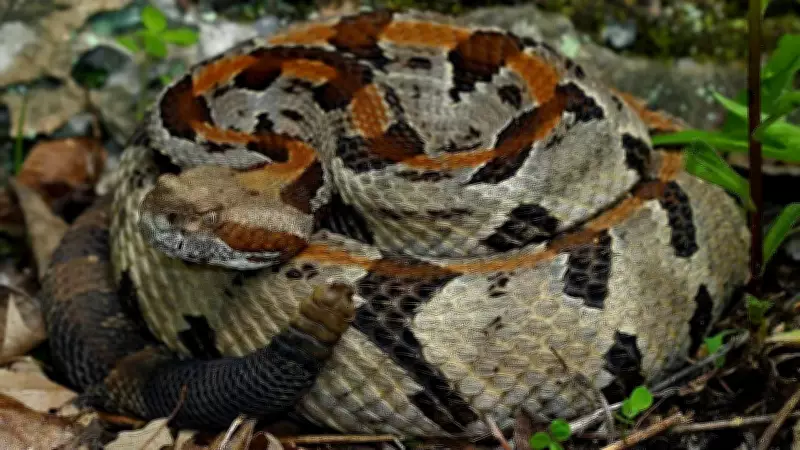
The timber rattlesnake (Crotalus horridus) rarely matches the dramatic expectations people carry into the woods. Across the eastern United States, from New England's rocky ridges to the Carolinas and the foothills of Texas and Kansas, this species is widespread on paper but surprisingly elusive in practice. Most hikers and field researchers go years without a confirmed sighting, not because the snake is absent, but because it is built for invisibility and restraint.
How Timber Rattlesnakes Appear in the Wild
When it does appear, the encounter often begins as a sound or a sudden sense of movement in leaf litter. The snake itself is typically thick-bodied, grounded, and visually fused with its surroundings. Its coloration ranges from muted gray and beige tones to darker, high-contrast patterns that dissolve into forest floor textures. A broken dorsal stripe and chevron-like side markings further disrupt its outline, making still individuals easy to overlook.
The timber rattlesnake is a large pit viper distributed across the eastern half of the US. Adults typically reach 2.5 to 5 feet (0.76 to 1.5 meters), though some individuals can grow to about 7 feet (2 meters). In practice, most field encounters reveal a snake that looks heavier than expected, with a thick body that merges with the ground.

Coloration varies significantly. Some individuals carry a gray base with a faint pink or beige tint, while others trend darker. The dorsal stripe may be yellow, orange, brown, or nearly black. Along the sides, darker chevron-like bands help break up the outline in leaf litter. This camouflage renders the snake nearly invisible until it moves or vibrates its tail.
Identifying Timber Rattlesnakes: Key Characteristics
Field identification relies on structural markers rather than coloration. The head is broad and distinctly triangular, driven by venom glands behind the jaw. Heat-sensing pits sit between the eyes and nostrils, allowing detection of warm-blooded prey in near-total darkness. These pit organs function as infrared sensors tuned to temperature differentials.
The tail features the iconic rattle, which is not a single structure but a series of loosely interlocking keratin segments. Each time the snake sheds its skin, a new segment is added. However, segments frequently break off in the wild, so rattle count is an unreliable age indicator.
Defensive Sequence of the Timber Rattlesnake
The rattling sound is mechanical, produced by muscle contractions in the tail that drive high-frequency vibration, causing hollow keratin segments to strike each other. This sharp, consistent sound carries well through underbrush.
Many assume the snake is angry or preparing to attack, but its behavioral sequence typically prioritizes stillness first, then warning, and only then defensive striking if pressure continues. In controlled environments, timber rattlesnakes often remain motionless even when approached, relying on concealment. Handlers note that strikes are rare when the animal is given spatial options.
Why Timber Rattlesnakes Persist in Forests but Disappear from Suburbs
The range of Crotalus horridus stretches across a large portion of the eastern US, but distribution is fragmented. The species has been regionally extirpated from parts of its historical range, including areas of southern Canada and portions of New England.
These snakes den in rocky crevices or subterranean spaces that can host multiple individuals, sometimes even multiple snake species. In colder months, dozens may congregate in a single den system, remaining largely inactive until spring. Urban and suburban expansion disrupts prey availability and den integrity. Roads create mortality corridors that adult snakes are slow to cross, increasing vulnerability in fragmented landscapes.
Hunting Strategy of the Timber Rattlesnake
In the wild, timber rattlesnakes primarily consume small to medium mammals such as mice, chipmunks, squirrels, and shrews. Birds, amphibians, and lizards also appear in their diet. The hunting strategy is ambush-based: the snake positions itself along rodent pathways and waits. Heat-sensing pits allow detection of prey movement even in low visibility. Once within range, the strike is rapid, and venom is injected through hollow fangs that fold against the roof of the mouth when not in use.

The venom is hemotoxic, disrupting blood clotting and tissue integrity. A bite to a human is a medical emergency requiring immediate treatment. However, bites are rare relative to encounters, largely because the snake's default behavior is avoidance and stillness rather than pursuit.