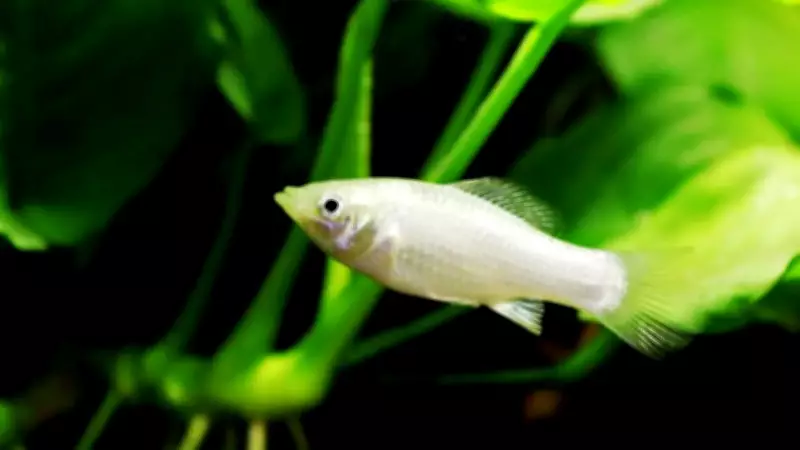
In the mystical world of evolution, the extinction of male species has always been seen as an end of evolution, but this rare fish species has survived as a living miracle for 100,000 years without male fishes. Here is all you need to know about their tale of defying the dynamics of evolution.
Sail Through Adversities
Amidst the warm rivers of Mexico and southern Texas swims a tiny silver fish that, according to modern science, simply should not be there, as they were once claimed to be surviving for a borrowed time on the surface of earth. That is the Amazon molly fish, named after the legendary all-female warriors of Greek mythology. This little creature has pulled off an incredible biological heist, and scientists are still wondering how. For roughly 100,000 years, the Amazon molly fish species has thrived without a single male in its ranks.
As per the theories of science, all-female species are destined to be short-lived blips on the radar and are on the verge of quick extinction. Yet, this unassuming fish continues to glide through the water, completely rewriting the rules of survival.

The Biological Heist
According to a report published in the BBC, to keep their lineage going, these female Amazon mollies travel in all-female shoals and copulate with males from closely related species. But there is a catch: she does not actually want his DNA. This natural trick of evolution is called gynogenesis, wherein she steals the male's sperm just to boost the development of her eggs. Once the spark is lit, his genetic material is promptly thrown away, and as a result, the female molly produces perfect, all-female clones of herself, generation after generation.
Why the Scientific World Is Stunned
To understand why scientists are losing their minds over this fish, you have to look at why fishes copulate in the first place. Crossing paths, competing for mates, and splitting DNA is an exhausting and unequal energy drain, especially for females. However, cloning oneself seems way more efficient. Yet, 99.9% of the natural world chooses sexual reproduction. Why? Because the act of mating defines evolution by mixing genes, creates healthy variety, and helps species adapt.
Without that genetic shuffle, species face a terrifying invisible clock known as Muller's Ratchet. Every time an organism clones itself, tiny copying errors slip into the DNA. Without a partner's healthy genes to balance things out, these bad mutations pile up like permanent clicks on a one-way ratchet, eventually causing the species to self-destruct.
The Evolutionary Scandal
The Amazon molly is not the only rule-breaker in the animal kingdom. There is an exclusive club of all-female species out there keeping genetic decay at bay. For instance, the Bdelloid rotifer, a microscopic creature the size of a grain of sand. Scientists call them an evolutionary scandal because they have survived for tens of millions of years without a single male, much like the Amazon molly.
The Act of Stealing
This may sound bizarre, but the Amazon molly has been thriving by literally stealing DNA from their environment and eventually plucking useful genes from entirely different organisms, like bacteria, to help them survive extreme heat, dehydration, and even the struggle to find space.
The Secret
While the Bdelloid rotifers are busy stealing environmental DNA, the Amazon molly uses a different superpower. A recent study co-authored by computational biologist Edward Ricemeyer revealed that the missing piece of the puzzle is a trick called gene conversion. Think of it as a built-in digital repair system. Because the very first Amazon molly was born 100,000 years ago from a fluke crossbreeding event between two different fish species, every molly today inherits highly diverse genetic traits. When a dangerous mutation pops up, the molly's cells do not panic. Instead, they use the healthy version of the gene as a template, copying and pasting it over the bad mutation.

Rewriting Evolution
Leaving scientists baffled, the copy-paste action of these fish does not just happen at random. In fact, the molly's body automatically triggers this mechanism most heavily in the exact spots where the most dangerous, life-threatening mutations try to take root. It turns out that the reproduction process is not the only way to keep a species healthy and vibrant. While scientists are still figuring out exactly how long this copy-paste strategy can ward off extinction, the Amazon molly is proof that nature always finds a workaround. She found a different path to the exact same destination, proving that life without fathers is not just possible, it can be an absolute masterclass in survival.