Chandigarh: An 18th-century copy of the Bhagavad Gita painstakingly written on a grain of rice, preserved at Panjab University's AC Joshi Library, is one of the institution's lesser-known treasures. Now, as the central government pushes to identify and preserve India's manuscript heritage, this tiny text, along with centuries-old Persian records, Sikh writings, and one of the earliest printed copies of the Constitution of India, is set to gain renewed attention.
Gyan Bharatam Programme
Panjab University has submitted details of its manuscript holdings under the Government of India's Gyan Bharatam programme. University officials confirmed that all required data related to the collections has been shared, and a designated team is expected to visit the university in approximately three months for further documentation and verification.
Manuscript Collections
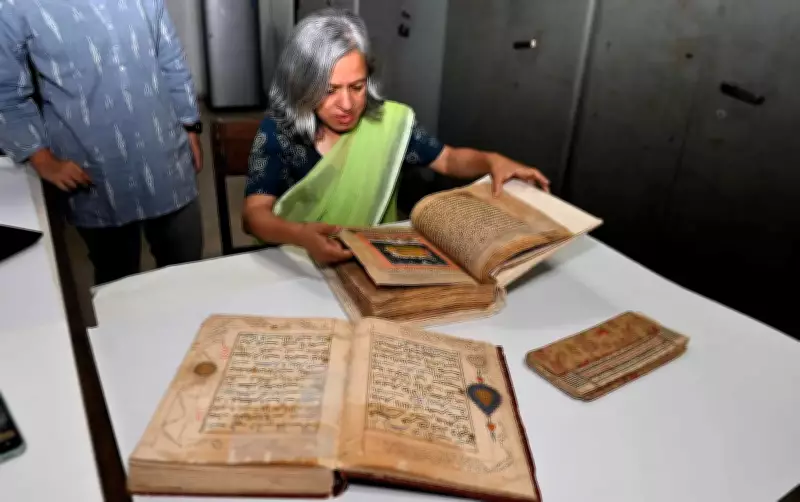
Located on the ground floor of AC Joshi Library, the manuscripts and rare books section houses 1,492 manuscripts in Hindi, Urdu, Persian, Sanskrit, Punjabi, and Sharda scripts. The collection spans Hindu scriptures, Persian court etiquette, poetry, writings of Sikh gurus, translations, and records pertaining to Maharaja Ranjit Singh's court.

Prized Possessions
Among the section's most prized possessions is the Bhagavad Gita written on a grain of rice, donated by a Panjab University alumnus from Amritsar. The repository also preserves one of the initial printed copies of the Constitution of India, among roughly 300 first prints, donated by former vice-chancellor M. M. Puri. Urdu manuscripts have been largely enriched through donations by Diwan Anand Kumar, forming a significant component of the archive's Persian and Urdu holdings.
Rare Books Collection
Beyond manuscripts, the library houses nearly 20,000 rare books dating from 1634 AD onwards. These include mutiny records, reports on scientific voyages such as HMS Challenger, educational records published by the Government of India since colonial times, surveys documenting the flora and fauna of British India, historical and geographical atlases, the Imperial Gazetteer of India, writings of viceroys and governor-generals, English factory records, and biographies. The collection also contains literature related to temples, gurdwaras, and mosques, works on Shakespeare and George Bernard Shaw, books on Sanskrit and Hindi literature and history, writings by medieval travellers, and scientific reports prepared by laboratories across India.
Expert Comments
Dr. Mritunjay Kumar, University Librarian at Panjab University, stated: "A manuscript is not merely an old document; it carries knowledge, memory and historical continuity. Panjab University has already shared all details required under the current exercise and the concerned team is likely to visit in around three months for the next stage."
International Interest
Researchers from Europe, the United States, and Arab countries regularly visit the repository for academic work, particularly for material related to Persian, Sikh, and colonial histories. Officials noted that the ongoing digitisation and documentation exercise is expected to improve accessibility while strengthening preservation efforts.
Future Plans
The push is also likely to extend to Panjab University's Swami Sarvanand Giri Regional Centre in Hoshiarpur, where manuscript-related documentation and preservation activity is expected to take shape as part of the broader exercise.

Key Highlights
- 1,492 manuscripts in Hindi, Urdu, Persian, Sanskrit, Punjabi, and Sharda scripts
- Nearly 20,000 rare books, some dating back to 1634 AD
- Gita written on a grain of rice, donated by a PU alumnus from Amritsar
- Rare Constitution copy donated by former VC M. M. Puri
- Major Urdu manuscript holdings donated by Diwan Anand Kumar