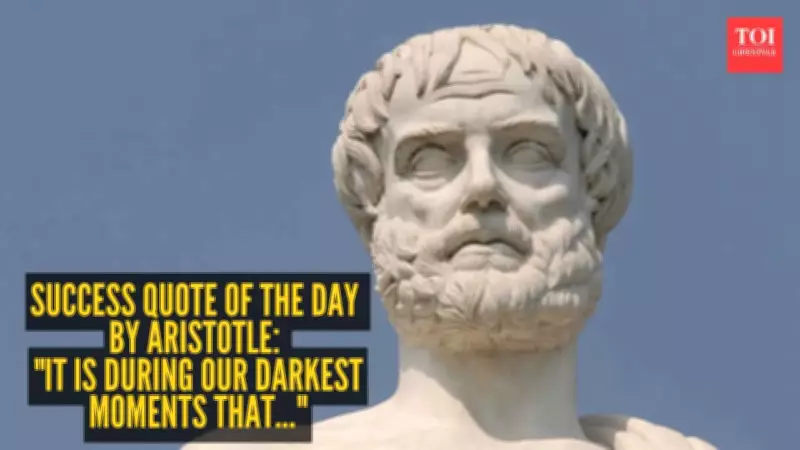
Aristotle's inspiring quote, 'It is during our darkest moments that we must focus to see the light,' serves as a profound reminder for navigating life's challenges. On the surface, it may seem like a poetic line for a greeting card, but when you are deep in the trenches of a rough patch, its meaning becomes starkly clear. Aristotle was not offering cheap comfort; he was providing a mental tool to survive the grind.
The Noise of a Bad Patch
When we talk about 'darkness,' it rarely refers only to major tragedies. Often, it is the subtle, exhausting stuff: a project that stalls, a strained relationship, deep self-doubt, or the suffocating feeling of burnout while getting nowhere. Our default response is to numb out—scrolling mindlessly, distracting ourselves, or panicking. Aristotle argues for the opposite: instead of looking away, sharpen your gaze. When the room goes pitch black, that is when you must pay the closest attention.
Cutting Through the Mental Fog
Uncertainty triggers the brain to replay past failures, invent worst-case scenarios, and question every life choice. This mental static is exhausting and blinds you to solutions. Choosing to focus does not mean pretending everything is fine; it means stopping the frantic panic to see what is in front of you. Quiet the background noise to spot tiny openings you would otherwise miss.

The Light Is Usually Small
The 'light' Aristotle mentions is rarely a massive miracle. In real life, it is subtle—a shift in perspective, a burst of clarity, or the nerve to walk away from something draining. In the middle of a mess, that light often looks like:
- A reality check: Realizing you are tougher than you thought.
- A micro-step: Doing one small, imperfect thing today instead of waiting for flawless conditions.
- Radical honesty: Dropping ego, admitting struggle, and asking for help.
Tough times act as a filter, stripping away superficial nonsense and forcing you to focus on core values, real priorities, and the few people who have your back.
How to Actually Use This
You do not need a massive life overhaul. Apply Aristotle's wisdom through tiny, real-time adjustments:
- Pause before you react. When panic sets in, force a timeout. Ask yourself: What can I control right now? Ignore the rest.
- Hunt for a micro-win. Stop obsessing over the big picture. Focus on one small task—send the email, clean your desk, work for five minutes. Momentum builds from tiny sparks.
- Treat friction as data. When you hit a wall, do not take it personally. Ask what the roadblock teaches you, and adjust your aim.
Pointing Your Flashlight
The real takeaway is that you still have agency, even when everything feels out of your hands. You cannot always control the situation, but you control where you point your attention. You can stare at the wall you hit, or scan the room for a way around it. Growth does not come from a life free of hardships; it comes from refusing to let hardships blind you. When you accept rough patches as part of the landscape, they lose their power to terrify. Your darkest moments did not come to break you—they forced you to see who you are and where you need to go next.