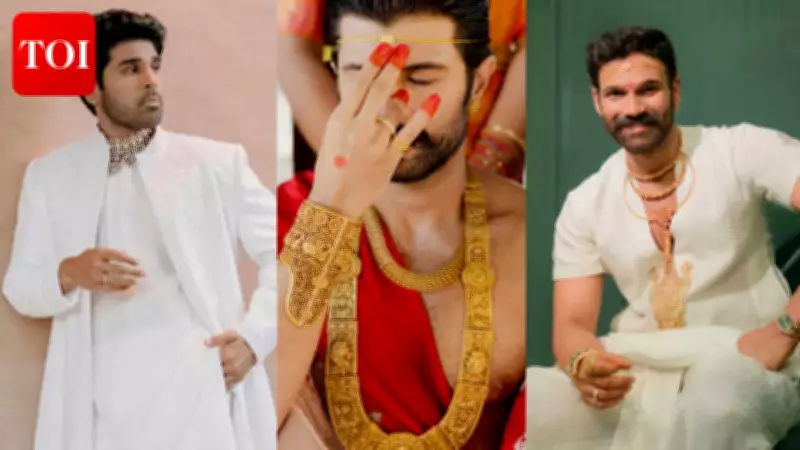
From Vijay Deverakonda's wedding chatter crediting him with having "shifted the groomswear conversation" to brothers Allu Arjun and Allu Sirish flaunting distinct personal styles at the latter's wedding celebrations, Telugu men have been steadily rewriting the rules of wedding dressing this year. Long associated with a relatively low bar for men's occasionwear, the conversation is now witnessing a visible shift — one marked by temple jewellery, layered pearls, brooches, kadas, and heirloom-inspired gold pieces. As ornamentation returns to the centre of men's wedding fashion, Hyderabad Times explores whether this growing embrace of jewellery signals a larger reawakening in how Telugu men approach style, tradition, and self-expression.
Allu Arjun and Allu Sirish: Distinct Styles at the Wedding
At brother Sirish's wedding celebrations, Allu Arjun accessorised with a meenakari enamel tassel pendant finished with delicate pearl drops. A kundan peacock ring set in gold, accented with colourful stones and pearl drops, added a touch of maximalism. The actor paired his ensemble with a silver payal worn on the ankle. For his engagement ceremony in October last year, Sirish opted for an intricately studded choker. Elevating his traditional ensembles, Allu Sirish showcased a curated mix of statement diamonds and gold jewellery across his wedding festivities.
Jewellery Has Always Been Part of Male Identity in India
For stylist Preetam Jukalker, the growing acceptance of statement jewellery is less about reinvention and more about reclaiming tradition. "Earcuffs and statement jewellery have historically been worn by men across Telangana, Rajasthan, Karnataka, and Maharashtra. If you look at figures like Shivaji, jewellery was always part of their identity," he says. He believes celebrity styling has played a major role in normalising the look. "I loved how Vijay carried his wedding jewellery. It had a very divine, almost Ram-like presence. He was among the first male celebrities in the Telugu space to confidently embrace elaborate gold jewellery, and that gave people confidence to experiment more," he says.

Making a case for heritage-inspired maximalism, Vijay Deverakonda styled his wedding ensemble with standout pieces including a temple-style embossed long gold necklace, bajuband and kamarband. Crafted with intricate motifs, the gold wrist cuff lent a warrior-inspired edge to Vijay's wedding look. Yash Agarwal, creative director at Birdhichand Ghanshyamdas jewellers, emphasises the importance of staying rooted in tradition while adapting to modern fashion. "The balance lies in respecting heritage while presenting it in a way that feels fresh and relevant today," he says.
Men Are No Longer Content Being the Supporting Act
Stylist Shravya Varma sees the rise of men's jewellery as part of a wider shift towards more intentional dressing. "Men today are far more comfortable expressing their identity through fashion. Weddings, especially, have become deeply personal and visual experiences. Men are no longer content being the 'supporting act' — they want to show up with intention," she says. According to her, jewellery is increasingly becoming a way to blend heritage with individuality. "It's about editing, not erasing. I like to anchor the look in something traditional, maybe a classic motif or an heirloom piece, and then refine the rest. Cleaner lines, controlled layering, and thoughtful proportions make it feel current without losing its cultural weight," she explains.
Preetam Jukalker adds, "You can go minimal or maximal depending on the outfit and personality. In India, 'too much' is often just right because our culture celebrates abundance."
Rooted in Tradition, Designed for Today
Designers say today's demand lies in balancing craftsmanship with wearability. "Telugu jewellery has a lot of depth, history, and symbolism, and I think it's important to honour that first," says jewellery designer Sheetal Zaveri. "Our approach is to retain the essence of traditional designs while making them lighter, more wearable, and relevant for today." She points out that antique gold, matte finishes, and motifs such as Nandi, birds, and geometric patterns are increasingly resonating with younger clients. "Handcrafted textures and artisanal detailing are also gaining attention because they add subtle character to a look," she says.

Bellamkonda Sreenivas paired layered temple-inspired haarams and an emerald-and-diamond peacock necklace with sculptural heritage ear ornaments for his Tirumala wedding to Kavya Reddy.
By the Numbers: Men's Jewellery Market Growth
- 25–30% Year-on-year growth recorded by the men's jewellery segment in 2025
- 15% of men's jewellery now accounts for of India's overall jewellery market
- Rs 8.70 lakh crore Approximate value of India's jewellery market (US$ 94.14 billion)
- 23% Indian men who regularly wear jewellery
- 39% Consumers who view men's jewellery as a positive and culturally accepted form of self-expression
The Telugu Man's Guide to Wedding Jewellery
- Start with one statement piece — a brooch, layered pearl necklace, or kada — and build gradually
- Match the jewellery to the outfit's neckline and embroidery rather than over-layering everything
- Antique gold and matte finishes tend to feel more understated and wearable than highly polished pieces
- Heirloom jewellery can be restyled with contemporary silhouettes for a more personal touch
- Wedding guests can experiment with smaller accents like rings, buttons, or chains before moving to heavier temple jewellery
- Focus on balance: if the outfit is heavily embroidered, keep the jewellery cleaner and more minimal
About the Author: Divya Shree — Full-time Tollywood observer, lifelong movie buff. I wander through city stories, mental health conversations, women-in-cinema narratives, and weekend trends.