Ludhiana: While backyard poultry farming accounts for only 20% in India, Guru Angad Dev Veterinary and Animal Sciences University (GADVASU) has designed a poultry coop that blends closed and open spaces. This innovation aims to boost backyard farming scientifically, generating income and supporting livelihoods without significant investment.
Scientific Coop Design for Sustainable Farming
The Department of Livestock Production Management at GADVASU has developed a scientific backyard poultry coop design to promote sustainable poultry farming in Punjab and beyond. According to university experts, this initiative will expand backyard poultry farming scientifically, improving rural livelihoods, household nutrition, and quality poultry production.
Current Scenario and Benefits
Backyard poultry farming currently contributes only 20% of India's poultry production, with commercial poultry dominating the sector. However, commercial farming requires heavy capital investment and large infrastructure, making it inaccessible for small and marginal households. In contrast, backyard poultry farming can be expanded with lower investment while offering multiple social and economic benefits.

Coop Specifications and Features
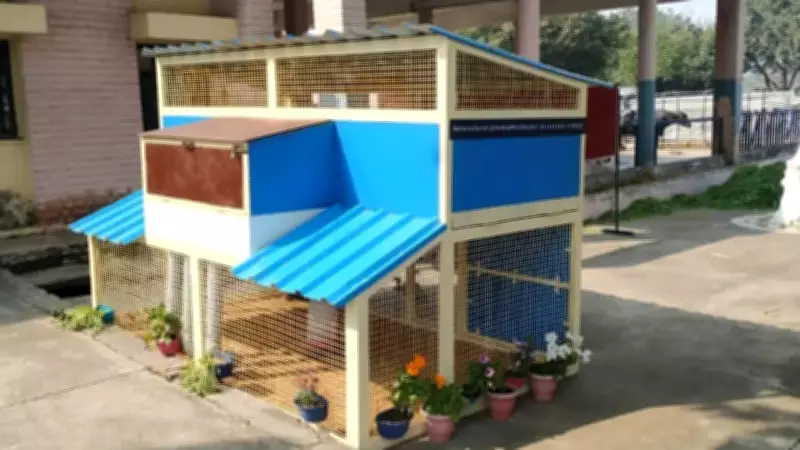
Daljeet Kaur, Associate Professor at the department, who designed and developed the coop, explained that the scientific coop accommodates 20 birds and provides both covered and open spaces for bird welfare and natural behavior. The covered area is 40 square feet, and the open area is 60 square feet, giving each bird 2.5 square feet of covered space and 3.5 square feet of run space for comfortable housing.
The model uses a double-deck system where birds move to the upper deck at night for safety and come down to the run area during the day for foraging, scavenging, and dust bathing. This system improves bird comfort, reduces stress, and ensures protection.
Natural Foraging and Feed Cost Reduction
Medicinal and fodder plants like mint, tulsi, coriander, patharchat, and asparagus can be grown around the run area. Through natural scavenging and foraging, birds can obtain nearly 30% of their feed requirement, reducing feed costs for households.
Nest Boxes and Lighting for Egg Production
The covered area includes specially designed nest boxes, as hens prefer laying eggs in dark, cool, and calm places with soft bedding. This arrangement also simplifies egg collection. The upper deck is fitted with lights to provide birds with four hours of additional lighting (two hours before sunrise and two hours after sunset) to improve egg laying.
Recommended Breeds
The university recommends improved desi breeds such as Punjab Brown, Punjab Red, and Desi Cross 1, along with other dual-purpose crosses suitable for backyard farming in Punjab. These improved varieties offer higher production and better immunity, serving dual purposes of eggs and meat for families and income generation.
Lower Inputs and Higher Immunity
Backyard poultry birds generally require fewer antibiotics and lower inputs compared to intensive commercial farms. Improved backyard breeds possess better immunity and can produce 200 to 250 eggs annually. Although commercial birds may produce 300 to 350 eggs, their management and input costs are significantly higher.
Integrated Manure Management System
The coop features an integrated manure management system. Trays at the bottom collect bird droppings, which are transferred to perforated compost drums for aerobic composting. Approximately two kilograms of manure generated daily is mixed with paddy straw to maintain a balanced carbon-nitrogen ratio of 20:1.
The composting system includes two connected drums, each with a capacity of around 120 kilograms, fitted with handles for rotation. The drums are rotated two to three times daily. Active composting occurs during the first 30 days, followed by curing over the next 30 days, with quality organic compost ready in about 90 days.
Additional Income from Compost
Apart from income from eggs and poultry meat, the compost can generate an additional value of nearly Rs 6,000 annually for households. It can be used in kitchen gardens and farms or sold commercially.

Promoting Scientific Backyard Farming
The model is designed to promote scientific backyard poultry farming that is economical, welfare-oriented, and suitable for rural families, especially women, while improving access to nutritious eggs and meat. A similar bamboo structure has also been created with the same benefits.
Dr. Yashpal Singh, Head of the Department, stated that backyard farming has multiple benefits and should be adopted scientifically by farmers. Farmers or entrepreneurs interested in learning and adopting this model can reach out to the department in groups.