There is an old, romantic notion that great art is born from pain. We often imagine a tortured genius, sleepless and miserable, channeling heartbreak into masterpieces. We tend to believe that if it did not cost us something, perhaps it is not real.
But not every artist fits this mold. Some of the most tender and alive work ever created came not from despair but from a silence, an unexplainable contentment. Some creators looked at what they had made and saw it simply in the shape of their own happiness, loving those pieces precisely for that reason.
Amrita Sher-Gil, a Hungarian-Indian painter often called one of the greatest avant-garde women artists of the early 20th century, reflected on this idea.

The Quote of the Day
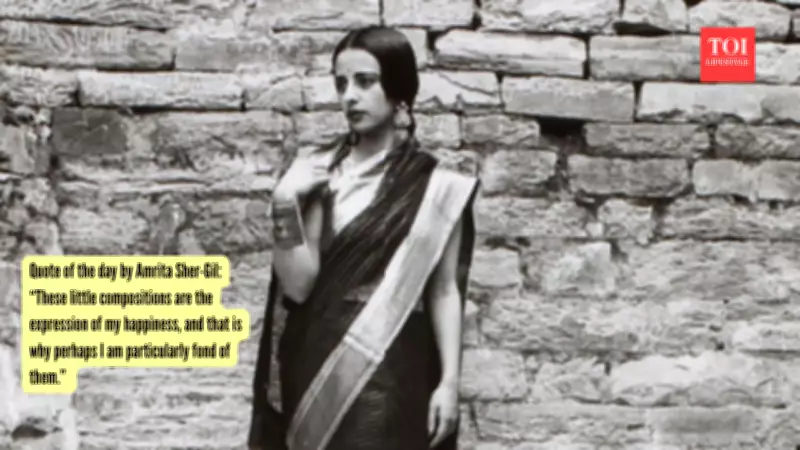
"These little compositions are the expression of my happiness and that is why perhaps I am particularly fond of them."
Amrita Sher-Gil wrote these words in a 1938 letter, describing a set of small paintings she made during an unusually happy period of her life. She was not referring to her grandest or most excellent canvases. Instead, she spoke of simple "little compositions" that brought her joy and contentment, admitting almost shyly that she loved them most because they held her happiness.
What the Quote Actually Means
The quote is a straightforward confession that her art was her happiness made visible. In the letter, addressed to critic Karl Khandalavala, she mentioned feeling "curiously happy" without knowing exactly why. She noted that these small works would always hold a tender spot in her heart, "even when my calm vanishes." She understood that the mood was temporary, but her paintings would remain as its record.
The Quote Stands Against the Myth of the Suffering Artist
We are often taught that pain sparks creativity, that real art demands real anguish. Sher-Gil's life had plenty of struggles and very little recognition while she was alive. Yet here she names joy, not suffering, as the inspiration for the work she treasured most. It is a quiet rebuke to the tortured-genius cliché: happiness can be generative on its own, not merely a pause between bouts of misery.
Who Was Amrita Sher-Gil?
Sher-Gil is widely recognized as a pioneer of modern Indian art. According to the National Gallery of Modern Art, she was born in Budapest in 1913 to a Hungarian mother and a Sikh aristocrat father. At just nineteen, her painting "Young Girls" made her the youngest Asian ever elected an Associate of the Grand Salon in Paris in 1933. She returned to India in 1934 to paint ordinary lives, especially those of women, and died tragically young at twenty-eight in 1941.
Her legacy continues to inspire artists and challenge conventional narratives about creativity and suffering.