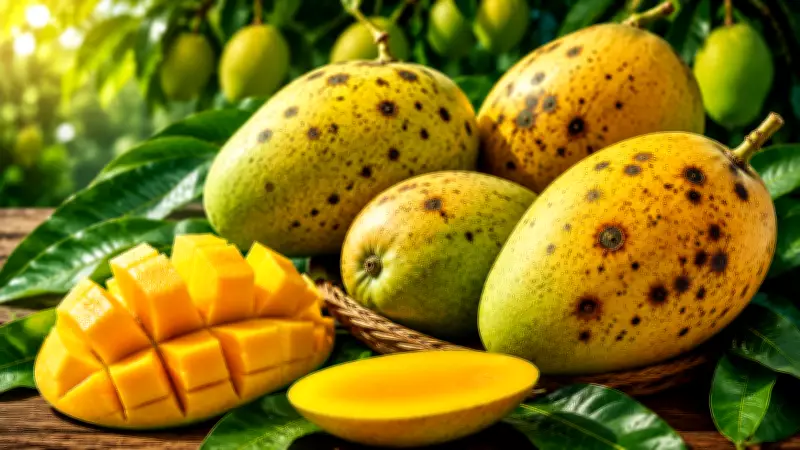
Malda's renowned Himsagar mangoes, which were expected to enjoy a sweet export season, have instead received a sour twist. Dark spots caused by a weather-induced disease have cast uncertainty over the export of West Bengal's prized mango variety. Exporters have indicated that a significant portion of the fruit may no longer meet overseas quality standards.
The issue has been attributed to continuous rainfall during the bagging stage of cultivation, followed by periods of high temperatures. Exporters explained that these conditions led to the appearance of dark spots on the surface of the mangoes, which are considered early signs of infection. Bagging, a process where individual fruits are covered with protective bags while still on the tree, is commonly used to enhance the appearance of mangoes and minimize damage from pests and diseases.
According to exporters, attempts to address the problem of dark spots on bagged Himsagar mangoes have not yielded results, rendering many fruits unsuitable for export markets and organized retail chains. Prasun Chitlangia, co-founder of Shrishti Food Products, told PTI, 'We were supposed to send the first consignment of mangoes to the US this week. We feared dark spots on the fruits, and it has come true. Had we exported the consignment, it would have been rejected by the importer as fruits have to be free of spots, which are an early sign of disease.' He attributed the situation to adverse weather during the growing season, stating, 'Continuous rain during the bagging period followed by high temperatures led to the problem. The situation is bad, we have a large number of export orders.'

The exporter had planned to dispatch a one-tonne consignment of Himsagar mangoes to the United States as Malda's first overseas shipment of the season. This development comes as exporters and officials had set an ambitious target of increasing mango and litchi exports from the district to more than 300 metric tonnes this season. The push had been backed by the expansion of export-focused cultivation methods and a growing number of farmers adopting fruit bagging practices.
Despite concerns over the disease, Malda Mango Merchants Association president Ujjal Saha expressed confidence in the district's export prospects. 'There have been reports of disease in around 15 per cent of the bagged fruits. But nearly three lakh more bagged mangoes are still available and can be exported. Orders for Himsagar mangoes continue to remain strong,' Saha said.
Earlier estimates by exporters had projected mango exports from the district at between 300 and 500 metric tonnes this season, a substantial rise from the nearly 15 metric tonnes shipped to five countries last year. To support export growth, the state horticulture department and exporters have been encouraging export-oriented cultivation practices, including fruit bagging, good agricultural practices (GAP), scientific harvesting, and improved post-harvest handling to ensure better fruit quality and compliance with international standards. Officials had distributed around 2.5 lakh fruit bags among growers and were overseeing 50 to 60 orchards that were following export-compliant cultivation methods.
The export basket this season was expected to feature premium mango varieties such as Himsagar, Langra, Lakshman Bhog, and Amrapali, along with litchis grown in Malda and neighboring Murshidabad district. Even as the disease-related setback affects immediate shipping plans, exporters said international demand for premium Malda mangoes remains strong, and efforts are underway to identify export-quality fruits from orchards that remain unaffected.